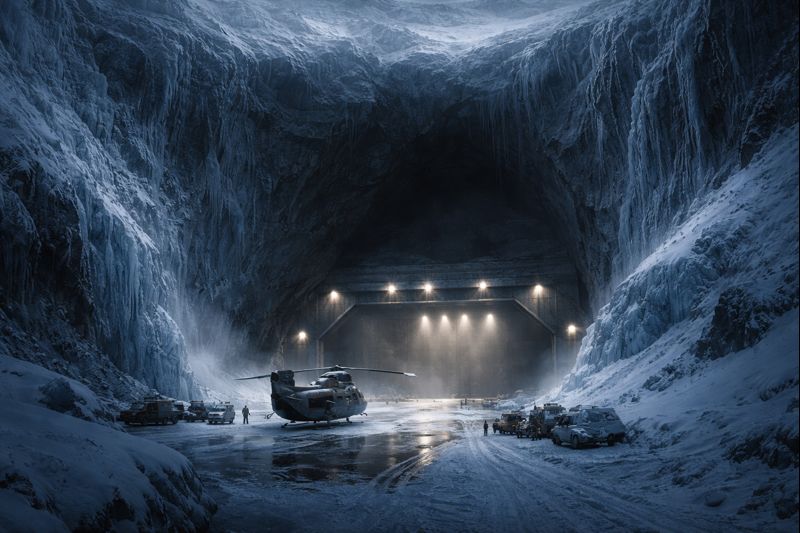
The snow sparkled like crystal in the dawn, and the wind whistled cold and harsh across the tundra, chasing the night things back to their dens.
The sun’s rising judgment created a quiet so loud everything stopped to listen.
Only the wind murmured.
Dr. Anton Levin watched from the helicopter window as they descended into what looked like the entrance to hell—a deep, open chasm split into the earth. The quiet pressed against him like a clasped hand, firm and inescapable, as though the devil himself were guiding him downward, fingers curled tight around his wrist.
By the time the helicopter touched down on the helipad, Anton barely noticed the rotors slowing. He scarcely registered the soldiers pressing transfer papers into his hands, or the way his signature sprawled across the page, clumsy and unfamiliar, written with a pen that felt as lifeless as he did. All he could feel was the cold—seeping through his parka, through his boots, straight into his bones.
Before he could gather the courage to turn back, the sliding glass doors parted before him, exhaling a rush of warm air that felt undeserved.
The foyer was massive and mostly empty, its ceiling unfinished, raw stone exposed like an open wound. Soldiers lingered along the walls, their postures relaxed, their eyes sharp. From somewhere above, water dripped steadily. A cold drop struck the back of Anton’s neck and he flinched.
The soldiers laughed.
Embarrassed, Anton approached them and asked for directions to Dr. Molozov’s lab. He had expected the doctor to meet him personally. No one present matched the description he had memorized.
The laughter faded.
One of the men removed his cigarette, stamped it out against the dirty insulated tiles, and gestured for Anton to follow. He did not speak.
The cavern stretched on for miles. The soldier stepped briskly onto a moving sidewalk, and Anton hurried to keep pace. Corridors branched outward in perfect lines, their walls smooth and pale, broken only by warning lights and sealed doors marked with symbols Anton did not yet recognize. Everything smelled faintly of disinfectant and metal. Overhead, the lights hummed—not loudly, but constantly—as if reminding him the facility was awake, even if the people inside wished it weren’t.
Anton followed in silence.
They passed a series of laboratories first, each labeled Lab 1… Lab 2… and so on. Stainless steel tables gleamed behind thick panes of glass, where figures in lab coats moved with practiced efficiency, their tasks unreadable from the corridor.
Among the apparatus were restraints bolted directly into the floors, their purpose unmistakable. Instruments too specialized for Anton’s clearance crowded the benches. Some rooms lay dark and abandoned, while others glowed with sterile activity. In one, he noticed a smear on the floor that had been cleaned poorly—the stain, tinged with rust, faint but stubborn, like a thought that refused to leave.
It was a large stain.
It spread across most of the room.
He tried not to think about it.
They exited the moving sidewalk before a darkened hallway. The soldier slowed, his eyes lingering on the black corridor ahead. He fidgeted with his cigarette pack, opening and closing it, considering another before finally slipping it back into his pocket.
“Do you know what you’re getting into?” the soldier asked quietly.
Anton tensed as the sound of a door creaking open echoed somewhere down the hall… then slowly closed. His ears strained, searching for whatever unseen thing now occupied the space beyond the light.
The soldier shifted, placing a hand on his holster.
“You came at a bad time,” he said. “It’s not for me to say…” His gaze drifted down the hallway again.
“This corridor,” he continued, “you’ll hear it called Monster Hallway. You’ll find out why soon enough.” He hesitated, then added, “For now, I’ll take you to the late Dr. Molozov’s office. His replacement will brief you.”

 Howlietzer Publishing
Leave a comment