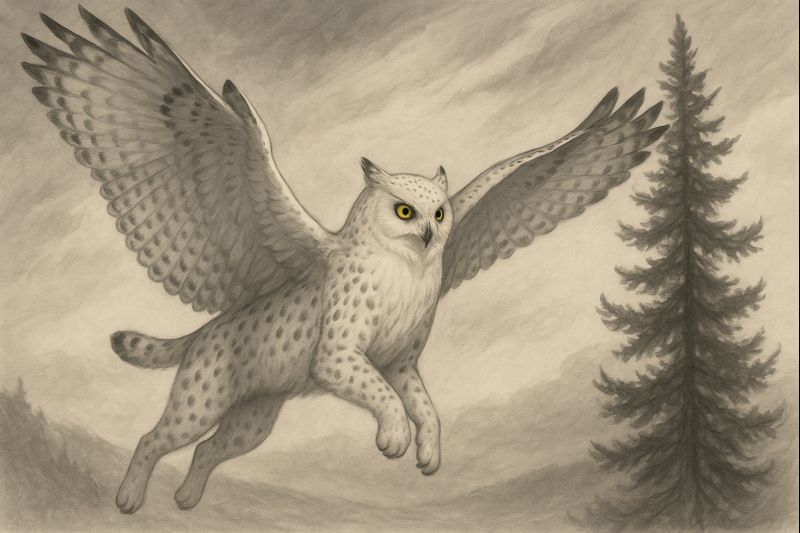
THE NORTHERN OWLCAT
Strix rufus glacialis — “The Ghost of the Pinewoods”
Classification: Mid-Size Chimeroid Predator
Habitat: Boreal forests, high Appalachian ridges, northern Rockies, subarctic pine belts
Temperament: Silent, elusive, fiercely territorial
Physical Description
The Northern Owlcat is a compact yet formidable hybrid of snowy owl and bobcat, built for survival in cold, forested environments. Its form is a seamless fusion of feather and fur, lending it an almost supernatural ability to blend into snowy undergrowth or moonlit branches.
Distinct Features
- Head: Rounded and feathered like a snowy owl, with piercing yellow eyes capable of seeing through blizzard conditions. Small, sharp-tipped ear tufts mimic a lynx’s silhouette.
- Wings: Long, broad, and silent—snowy owl wings engineered for stealth flight. When fully extended, they span nearly twice the creature’s body length.
- Body: Compact and muscular, covered in dense white fur marked with charcoal-gray bobcat spots. This coat provides insulation and camouflage in snow-blanketed forests.
- Tail: Short and bobbed, with a dark tip—perfect for maneuvering through pine branches without noise.
- Feet: Forepaws feathered and tipped with curved talons, a deadly combination of bobcat strength and raptor precision.
Standing only twenty to twenty-four inches at the shoulder, it is smaller than a typical griffin-type, but do not mistake its size for harmlessness.
Behavior and Abilities
The Silent Glide
The Owlcat’s most iconic behavior is its method of hunting:
From a pine branch high above, it spreads its great wings and enters a near-motionless glide, descending toward prey with total silence. Its wing feathers absorb sound, while its bobcat musculature allows for sudden mid-air changes in direction.
This gliding attack is the origin of many local legends describing
“a ghost drifting down from the treetops.”
Winter Camouflage
Its snowy coat and spotted markings break up its silhouette, even while in motion. Under fresh snowfall, an Owlcat can remain invisible until the moment it pounces.
Territorial Intelligence
The species is solitary except during winter pairing season. Each Owlcat maintains a radius of forest claimed through:
- Scratched markings on trees
- Talon grooves on boulders
- Hanging owl-like pellets containing fur and bone
Trespassing animals are chased away with shrill, owl-like shrieks—far louder than their size would suggest.
Diet
They prey on:
- Snowshoe hares
- Mink
- Grouse
- Small deer fawns
- Occasionally, raccoons or fox kits
When food is scarce, they glide-fish along frozen riverbanks, plunging through thin ice with spear-like talons.
Habitat and Range
Northern Owlcats thrive in:
- Deep boreal forests of Canada
- Upper Great Lakes wilderness
- Northern Rockies
- High elevations of the Appalachians (rare and disputed)
They prefer old-growth pine and fir where thick branches provide launch points for gliding.
Cultural Significance
Several First Nations tribes associate the Owlcat with:
- Shapeshifters
- Dream-walkers
- Forest guardians
Because of its silent nature and bright yellow eyes, it is often called “The Lantern in the Snow.”
European settlers recorded sightings as early as the 1700s, typically describing it as:
“A white forest cat with owl wings descending like a specter.”
Modern cryptid researchers classify it as one of the Subarctic Chimera Forms, related to but distinct from the larger American Griffin.
Threat Level
Moderate.
The Northern Owlcat avoids humans and rarely attacks unless:
- It is cornered
- Its nesting grounds are disturbed
- Hunger drives it to desperation during deep winter
When forced to fight, it unleashes a terrifying mix of aerial dives, slashing talons, and disorienting owl shrieks.
Most hikers who report encounters describe hearing nothing at all—until it’s already landing nearby.
 Howlietzer Publishing
Leave a comment