THE AMERICAN GRIFFIN
Haliaetus pumae — “The Eagle-Lion of the New World”
Classification: Apex Chimeroid
Habitat: Rocky Mountains, Yellowstone Plateau, Sierra Nevada
Temperament: Noble, territorial, calculating
Physical Description
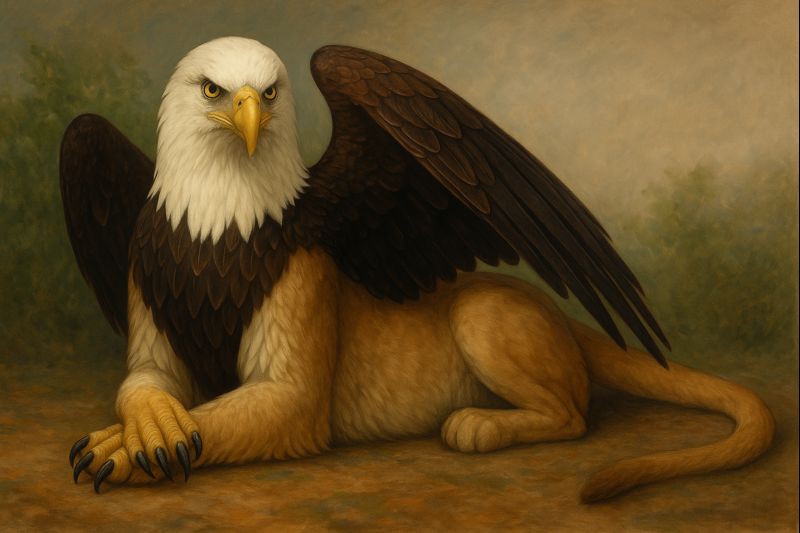
The American Griffin is a hybrid beast formed from the union of two of North America’s most revered predators: the bald eagle and the mountain lion. Sleek and powerfully built, this griffin carries the regal intensity of an eagle and the silent strength of a big cat.
Its head and chest are covered in immaculate white feathers that transition into deep brown along its shoulders and wings. The breast feathers extend down its torso, tapering into short plumage that merges naturally with tawny mountain lion fur.
The forelimbs are unmistakably raptorial — golden scaled arms ending in curved black talons designed for crushing bone and gripping sheer cliff faces. The hindquarters resemble a lean mountain lion, long and muscular, bred for stealth and power. Its tail, unlike the tufted tail of the Old World lion, is a long, expressive mountain-lion tail used for balance during aerial maneuvers.
Most specimens measure around nine feet from beak to tail, with wingspans exceeding fourteen feet.
When resting, the American Griffin often lies with forelimbs crossed, wings partially open — a posture that appears regal and contemplative, yet ready to explode into motion at any moment.
Behavior and Abilities
Aerial Hunter of the High Country
The American Griffin is one of the few creatures capable of predatory flight at high altitudes. Its eagle half grants unmatched eyesight: it can identify a moving object the size of a rabbit from over a mile away.
In the air, it combines:
- Eagle stooping speed (up to 120 mph)
- Mountain lion agility, able to twist or bank with unnerving precision
- A silent glide that precedes most of its ambushes
Territorial Intelligence
Unlike the more chaotic American Chimaera, the American Griffin is highly intelligent and exhibits:
- Complex territorial boundaries
- Long-term nesting sites
- Cooperative hunting when raising young
It is fiercely loyal to mates and offsprings, forming small familial prides known as echelon clutches.
Combat and Defense
When threatened, the griffin employs:
- A thunderous wing-beat capable of knocking a grown elk off balance
- A razor-precise beak strike, often fatal
- Talon grapples that immobilize prey instantly
Though naturally noble and stoic, a cornered American Griffin becomes a whirlwind of talons and feathers.
Habitat and Range
Sightings most commonly occur in:
- High cliffs of the Rocky Mountains
- Pine forests around Yellowstone
- Alpine ridges of the Sierra Nevada
- Rare, disputed sightings in the high Appalachians
They build nests — called eires — the size of small cars, constructed from fallen logs and bones of previous kills.
Cultural Significance
Among North American tribes, the griffin symbolizes:
- Watchfulness
- Protection
- Divine justice from the mountains
Early pioneers believed spotting one was a sign of fortune on long journeys… unless it circled overhead more than twice, which was considered a dire omen.
Modern cryptid researchers classify it as one of the “High Clade Guardians,” alongside the Thunderbird and the Iron Elk.
Threat Level
High, but avoidable.
American Griffins seldom attack humans unless:
- Their nest is threatened
- They are wounded
- A traveler is mistaken for a rival predator
If spotted resting with wings half-open, it is not an invitation — it is a warning.
 Howlietzer Publishing
Leave a comment