Tag: sci-fi military

  • Fort Wichmann

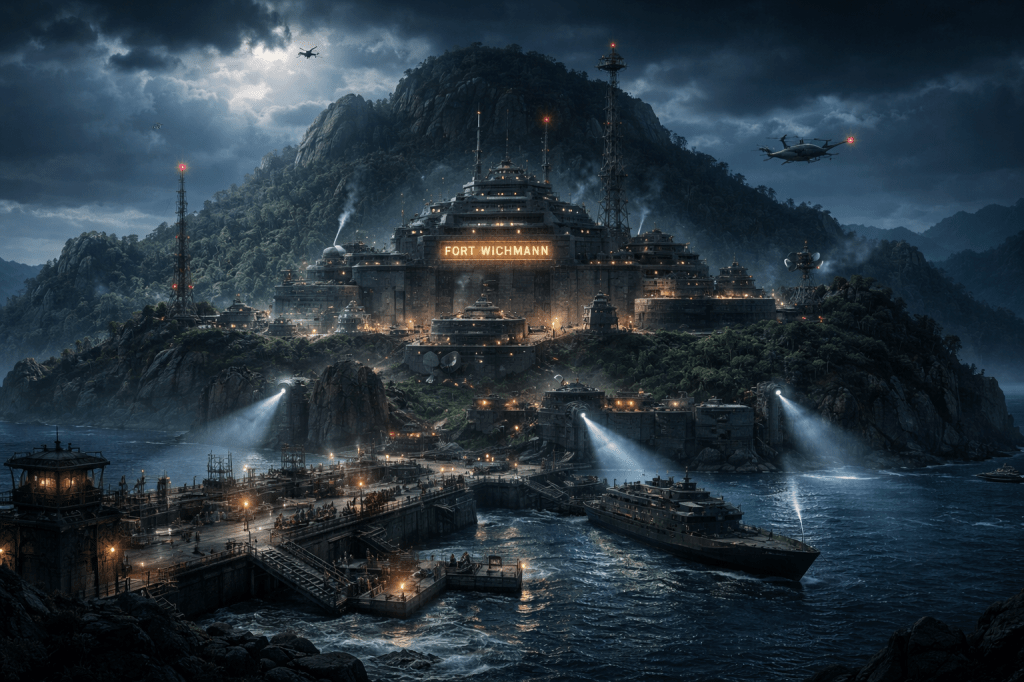
    Fort Wichmann

    Mission

    In 1918, the USS Cyclops vanished during a voyage from Brazil to Baltimore. After a scheduled stop in Barbados, the vessel was never seen or heard from again.

    Officially, the ship was lost at sea.

    Unofficially, its mission was far more deliberate.

    The USS Cyclops had been tasked with establishing a covert United States military installation at 25° North latitude, 71° West longitude—deep within what would later be known as the Bermuda Triangle.

    At the time, a massive island had risen at those coordinates, likely the result of tectonic activity beneath the Atlantic Plate. How long it had existed before surfacing, or whether it had been observed by other nations, remains unknown. What mattered to U.S. military planners was speed. The island could not be allowed to fall into foreign hands.

    The decision was made: the United States would claim it first.

    All personnel connected to what would later be known as Fort Wichmann assembled in Rio de Janeiro in early February of 1918. The USS Cyclops departed port on February 16. No confirmed transmissions were ever received after that date.

    Captain Worley

    Captain George Worley was born Johan Frederick Wichmann on December 11, 1862, in Sandstedt, Hanover, Germany. He arrived in the United States in 1878 after jumping ship in San Francisco.

    In 1898, he changed his name to George Worley and established himself along San Francisco’s Barbary Coast, where he owned and operated a saloon. There, he developed close ties with sailors, smugglers, and merchants operating at the edges of legality.

    Eventually, Worley returned to the sea.

    He served as master of several merchant vessels and earned a reputation for moving illicit cargo—opium among it—quietly and efficiently. His experience, discretion, and willingness to accept jobs others refused brought him to the attention of the United States Navy.

    When the opportunity arose to command a mission requiring absolute secrecy and moral flexibility, Worley was approached.

    He was never intended to be more than transportation.

    Upon arrival at the island, Captain Worley was executed by Colonel Alistair Vane, the mission’s true commanding officer, who had been embedded among the crew from the outset. The killing was swift, deliberate, and uncontested.

    The island—and later the fort—would bear Wichmann’s name.

    The Crew

    The final complement of the USS Cyclops was deliberately unconventional.

    It included fringe scientists from across the world, many suspected—or known—to have participated in unethical research. Tradesmen were recruited for their skills and their disposability: men in debt, social outcasts, or individuals unlikely to be missed.

    Convicts were selected not for their danger, but for their compliance—offered reduced sentences in exchange for service. Alongside them were military personnel of mixed distinction: some honorable, others disgraced, many motivated by promises of redemption, freedom, or blind patriotism.

    Not all respected Colonel Vane’s authority.

    Enough feared it.

    A small cadre of loyal soldiers ensured discipline, order, and silence during the island’s earliest days.

    These were the people chosen to build Fort Wichmann.

    They were considered replaceable.

    The Facility

    The island itself was vast—far larger than initial surveys suggested—and continued to grow as the military reshaped it. Excavation, dredging, and controlled detonations expanded its usable landmass, reinforcing the belief that the island was not entirely stable.

    Ships arrived at the facility with regularity. Few ever departed.

    Those that did were required to falsify their logs to obscure the island’s location. Officially, many were still part of the ongoing search for the lost USS Cyclops. Other disappearances in the region helped give rise to the legend of the Bermuda Triangle.

    Navy vessels delivered supplies, construction materials, test subjects, and specialized equipment necessary for research and development. Over time, Fort Wichmann expanded into a sprawling black site, quietly siphoning funds through Pentagon channels to ensure its survival beyond official oversight.

    The base housed six top-secret scientific laboratories and a vast military training complex. Research focused on biological weapons, human augmentation, temporal physics, paranormal phenomena, and the anomalous behavior of the surrounding region.

    Strange occurrences were common.

    Hostile non-human entities—commonly referred to in early reports as goblins—inhabited the island’s interior. These man-eating creatures caused persistent casualties and required constant containment operations, shaping both the facility’s defenses and its training doctrine.

    Fort Wichmann Today

    Fort Wichmann remains operational.

    Personnel are rotated through extended deployments under strict non-disclosure agreements. Survivors return to the world carrying pieces of the truth they are never permitted to speak aloud.

    The base now functions as a training and testing ground for elite special forces units and experimental programs. The BMCR initiative, launched in 2004, has completed its first operational iteration. A second class is currently in training.

    As it has since its inception, Fort Wichmann exists at the intersection of science and warfare—striving to remain the pinnacle of both, no matter the cost.

  • Nadia Baranski / Slenderfoot

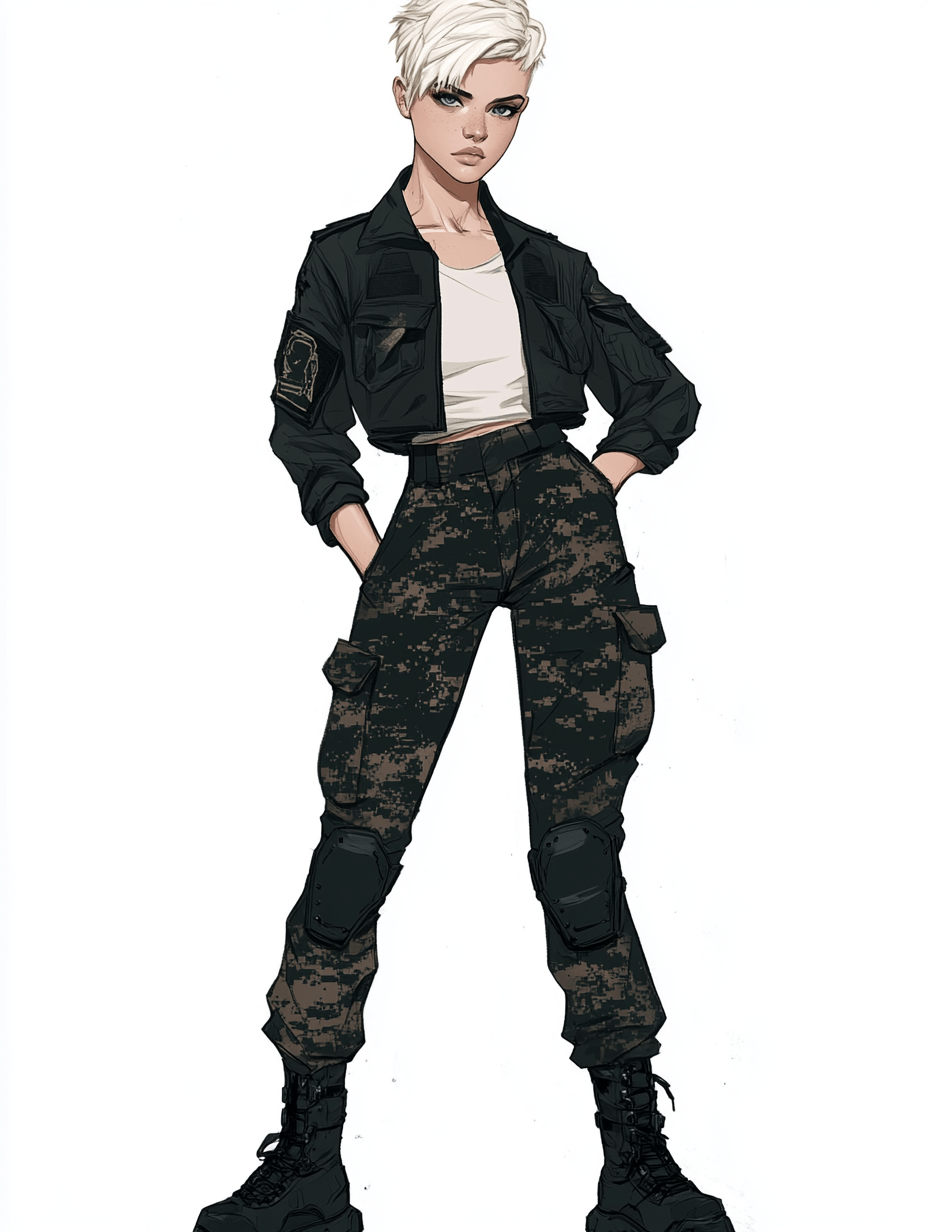
    Nadia Baranski / Slenderfoot

    Bio: Nadia is a Russian genetic experiment created during the cold war. She is a chimaera of human, viper, polar bear, tiger, wolf, wolverine, and kangaroo. Her mission is to infiltrate the Secret American training facility Fort Wichmann and steal their tech schematics and information.

    Currently, she lives in the secret Russian Military Science facility Schwanwitsch with her four brothers, coach, scientists and military personnel .

    • Age: 5 years; genetically aged to 20
    • Height: 5’5″
    • Weight: 150lbs
    • Class: Monster – shapeshifts into a chimaera creature based on her genetic manipulation.
    • Personality: Highly competitive, fun-loving, and a bit naive.
    • Skills: proficient in hand to hand combat, espionage, and subterfuge
    • Weaknesses: though engineered to be an unstoppable weapon, her handlers fitted her, and her brothers, with explosives at the base of their necks.
    • Fears: Nadia is afraid of technology implants
    • Pet Peeve: Losing
    • Favorite food: Pelmeni
  • How to Write Military Fiction That Keeps Readers Hooked

    How to Write Military Fiction That Keeps Readers Hooked

    War is a highly captivating theme that can capture a reader’s interest in military fiction. The significance of military stories in today’s world of fiction cannot be overstated, although writing military fiction is challenging. This genre demands action, accuracy, and storytelling finesse. Writers often face the dilemma of balancing realism with reader engagement while writing such narratives.

    If you’re planning to create a military fiction of your own and facing the right point to start, you are not alone. Here is a step-by-step guide on how you can write engaging military fiction that has the power to hook the readers till the end.

    Understanding the Military World

    The first thing you need to know about writing military fiction is that you’ll have to do a lot of reading. When your readers open your book, they expect the details to be as realistic as possible. You don’t have to be a soldier to know about all this, but it helps to know about ranks, tactics, and weaponry.

    Today’s readers are smart; if something does not fit in how they imagine a battle sequence or a soldier’s life, they’ll not continue reading. If you want your book to have a better hook and an immersive story, you’ll need to consult books that have previously executed this job with flying colors.

    For instance, “How to Make a Monster: The Slenderfoot Story” by S. T. Hatlaban can be a great reference to start. This book is set against a ruthless cold war, blending geopolitics and sci-fi in an enigmatic story. Reading this book can teach you quite a few things about the right way to depict war realistically.

    Developing Strong Characters

    A compelling military fiction highly relies on its main characters. For readers to continue reading the book till the end, the characters need to have some relevance and depth to them. Think of it as adding layers to the people in your story; give them strengths, but also don’t leave out their weaknesses. Show them going through the whole metamorphosis, showing their emotional and physical growth.

    If you are working on your main character, develop their background and where they come from. What drives them? Are they the men who’ve fought in many battles, or is this their first war?

    Make sure your characters’ reactions to events feel genuine. How would someone react to losing a comrade or making a tough battlefield decision?

    A great example can be found in “How to Make a Monster: the Slenderfoot Story.” In this novel, the author skillfully interconnects the characters’ feelings with the action occurring in a battle scene. It also signifies that your characters’ arcs are as significant as the wars they wage, so do your homework when creating your original story.

    Writing Gripping Action Scenes

    A good battle scene does not contain mere explosions or gunfire sounds but strong action sequences with great tactics, intense pressure, and high stakes.

    Here’s a simple tip: Plan your fight scenes before you write them. Consider where each character is located, what they want to achieve, and how they will achieve it.

    Don’t create your scenes with too much professionalism; never go extremely technical about the weapons. Yes, realism is crucial, but so is readability.

    The best battle scenes are detailed and include the reader in the scene. Let them breathe adrenaline, feel the gunshots, and experience the consequences of actions taken in the heat of the operation.

    A perfect example of this technique is in “How to Make a Monster,” where the author vividly describes thrilling action sequences involving Dr. Fyodor Molozov and his partner, Dr. Ekaterina Markov. Together, they journey through Russia’s frigid expanse with the help of their shape-shifting armies and guard the honor of their territory. The author, Hatlaban, with the help of illustrator D. Dart, has turned every action sequence into a cut-throat competition between opposing forces. As you read through the pages, you’ll come to know what it takes to craft a truly riveting military fiction story.

    Common Mistakes to Avoid

    Some writers often make common mistakes when writing military fiction, which can be easily avoided if they do the following.

    First, do not confuse your readers with redundant or complex technical terms. Since you’re writing for laypeople, you should know that not everyone is aware of the military language. Like AWOL (Absent Without Leave) and MIA (Missing In Action), which may confuse those unfamiliar with military language.

    Ignoring the role of emotions in war. Let your characters have moments where they can sit down, observe the situation, and contemplate a given event.

    Finally, keep your story fresh. If every battle scene feels the same, readers will lose interest. Find ways to vary your action—use different settings, strategies, and motivations for each conflict.

    Why You Should Read “The Slenderfoot Story?”

    It perfectly captures the essence of military fiction and combines strategic battle scenes with deep character development. The Slenderfoot Story combines the excitement of a sci-fi story with the tension of the Cold War. It follows Nadia, a young shapeshifter, as she and her friends struggle with their identities and the true intentions of their creators. The story raises important questions about what it means to be human and the risks of ambition.

    The Slenderfoot Story’s engaging plot and complex characters are exactly what makes military fiction so popular. You’ll learn a lot by studying how the author builds tension, creates believable military scenarios, and writes characters who feel real.

    Time to Start Your Military Fiction Writing

    Writing military fiction takes time, patience, and a lot of creativity. But with the right tools and techniques, you can write a story that keeps readers on the edge of their seats. Whether you’re planning epic battles or quiet moments between comrades, remember to focus on realism and emotion.

    As a final tip, check out “How to Make a Monster: The Slenderfoot Story!” It’s packed with valuable insights and examples that can help shape your writing.

    Grab your copy now, take inspiration, and write stories that will captivate readers.