Mission
In 1918, the USS Cyclops vanished during a voyage from Brazil to Baltimore. After a scheduled stop in Barbados, the vessel was never seen or heard from again.
Officially, the ship was lost at sea.
Unofficially, its mission was far more deliberate.
The USS Cyclops had been tasked with establishing a covert United States military installation at 25° North latitude, 71° West longitude—deep within what would later be known as the Bermuda Triangle.
At the time, a massive island had risen at those coordinates, likely the result of tectonic activity beneath the Atlantic Plate. How long it had existed before surfacing, or whether it had been observed by other nations, remains unknown. What mattered to U.S. military planners was speed. The island could not be allowed to fall into foreign hands.
The decision was made: the United States would claim it first.
All personnel connected to what would later be known as Fort Wichmann assembled in Rio de Janeiro in early February of 1918. The USS Cyclops departed port on February 16. No confirmed transmissions were ever received after that date.
Captain Worley
Captain George Worley was born Johan Frederick Wichmann on December 11, 1862, in Sandstedt, Hanover, Germany. He arrived in the United States in 1878 after jumping ship in San Francisco.
In 1898, he changed his name to George Worley and established himself along San Francisco’s Barbary Coast, where he owned and operated a saloon. There, he developed close ties with sailors, smugglers, and merchants operating at the edges of legality.
Eventually, Worley returned to the sea.
He served as master of several merchant vessels and earned a reputation for moving illicit cargo—opium among it—quietly and efficiently. His experience, discretion, and willingness to accept jobs others refused brought him to the attention of the United States Navy.
When the opportunity arose to command a mission requiring absolute secrecy and moral flexibility, Worley was approached.
He was never intended to be more than transportation.
Upon arrival at the island, Captain Worley was executed by Colonel Alistair Vane, the mission’s true commanding officer, who had been embedded among the crew from the outset. The killing was swift, deliberate, and uncontested.
The island—and later the fort—would bear Wichmann’s name.
The Crew
The final complement of the USS Cyclops was deliberately unconventional.
It included fringe scientists from across the world, many suspected—or known—to have participated in unethical research. Tradesmen were recruited for their skills and their disposability: men in debt, social outcasts, or individuals unlikely to be missed.
Convicts were selected not for their danger, but for their compliance—offered reduced sentences in exchange for service. Alongside them were military personnel of mixed distinction: some honorable, others disgraced, many motivated by promises of redemption, freedom, or blind patriotism.
Not all respected Colonel Vane’s authority.
Enough feared it.
A small cadre of loyal soldiers ensured discipline, order, and silence during the island’s earliest days.
These were the people chosen to build Fort Wichmann.
They were considered replaceable.
The Facility
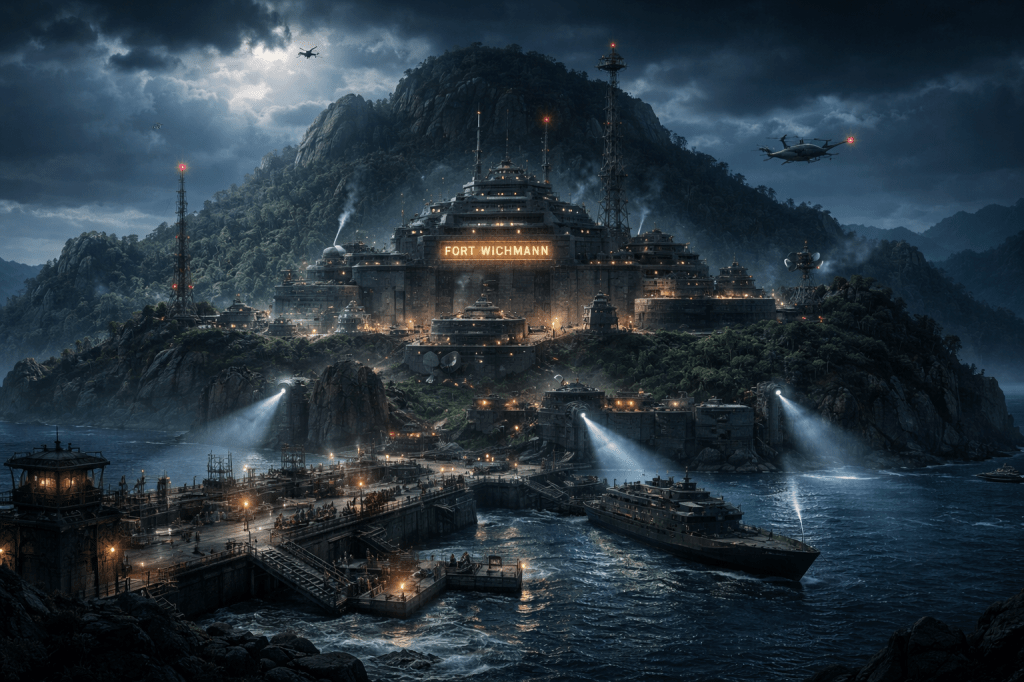
The island itself was vast—far larger than initial surveys suggested—and continued to grow as the military reshaped it. Excavation, dredging, and controlled detonations expanded its usable landmass, reinforcing the belief that the island was not entirely stable.
Ships arrived at the facility with regularity. Few ever departed.
Those that did were required to falsify their logs to obscure the island’s location. Officially, many were still part of the ongoing search for the lost USS Cyclops. Other disappearances in the region helped give rise to the legend of the Bermuda Triangle.
Navy vessels delivered supplies, construction materials, test subjects, and specialized equipment necessary for research and development. Over time, Fort Wichmann expanded into a sprawling black site, quietly siphoning funds through Pentagon channels to ensure its survival beyond official oversight.
The base housed six top-secret scientific laboratories and a vast military training complex. Research focused on biological weapons, human augmentation, temporal physics, paranormal phenomena, and the anomalous behavior of the surrounding region.
Strange occurrences were common.
Hostile non-human entities—commonly referred to in early reports as goblins—inhabited the island’s interior. These man-eating creatures caused persistent casualties and required constant containment operations, shaping both the facility’s defenses and its training doctrine.
Fort Wichmann Today
Fort Wichmann remains operational.
Personnel are rotated through extended deployments under strict non-disclosure agreements. Survivors return to the world carrying pieces of the truth they are never permitted to speak aloud.
The base now functions as a training and testing ground for elite special forces units and experimental programs. The BMCR initiative, launched in 2004, has completed its first operational iteration. A second class is currently in training.
As it has since its inception, Fort Wichmann exists at the intersection of science and warfare—striving to remain the pinnacle of both, no matter the cost.
 Howlietzer Publishing