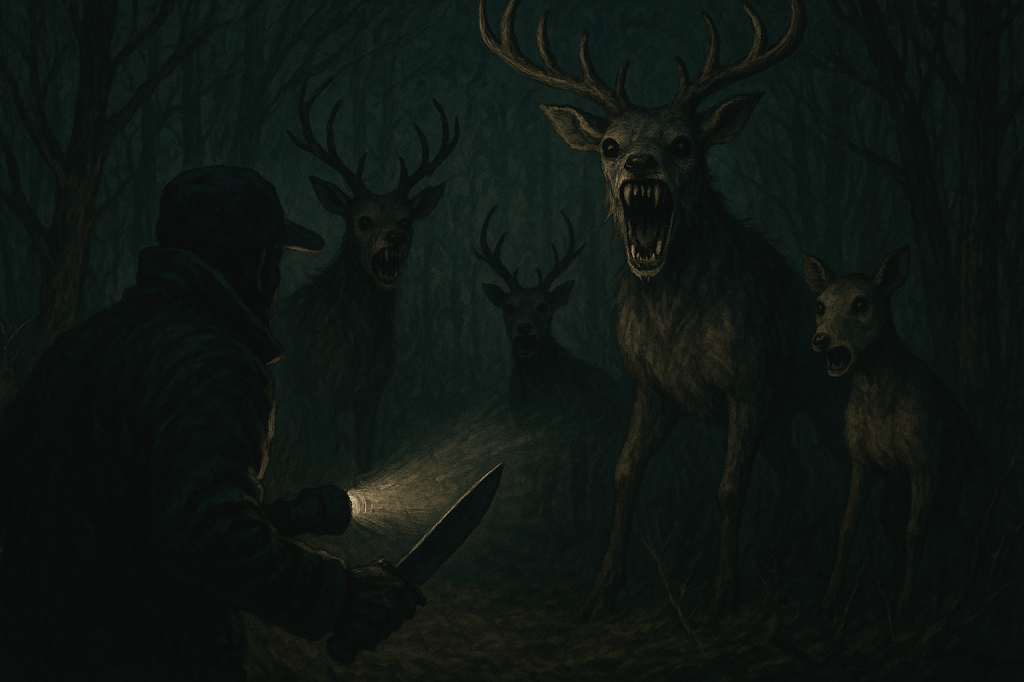
American Beastiary Entry: The Not-Deer
Common Name: Not-Deer
Other Names: The Wrong Buck, Hollow Stag, Skinwalker Deer, The Watching Herd
Classification: Mimetic Predator / Appalachian Cryptid
Threat Level: Extreme
Status: Active, Uncontained
Description
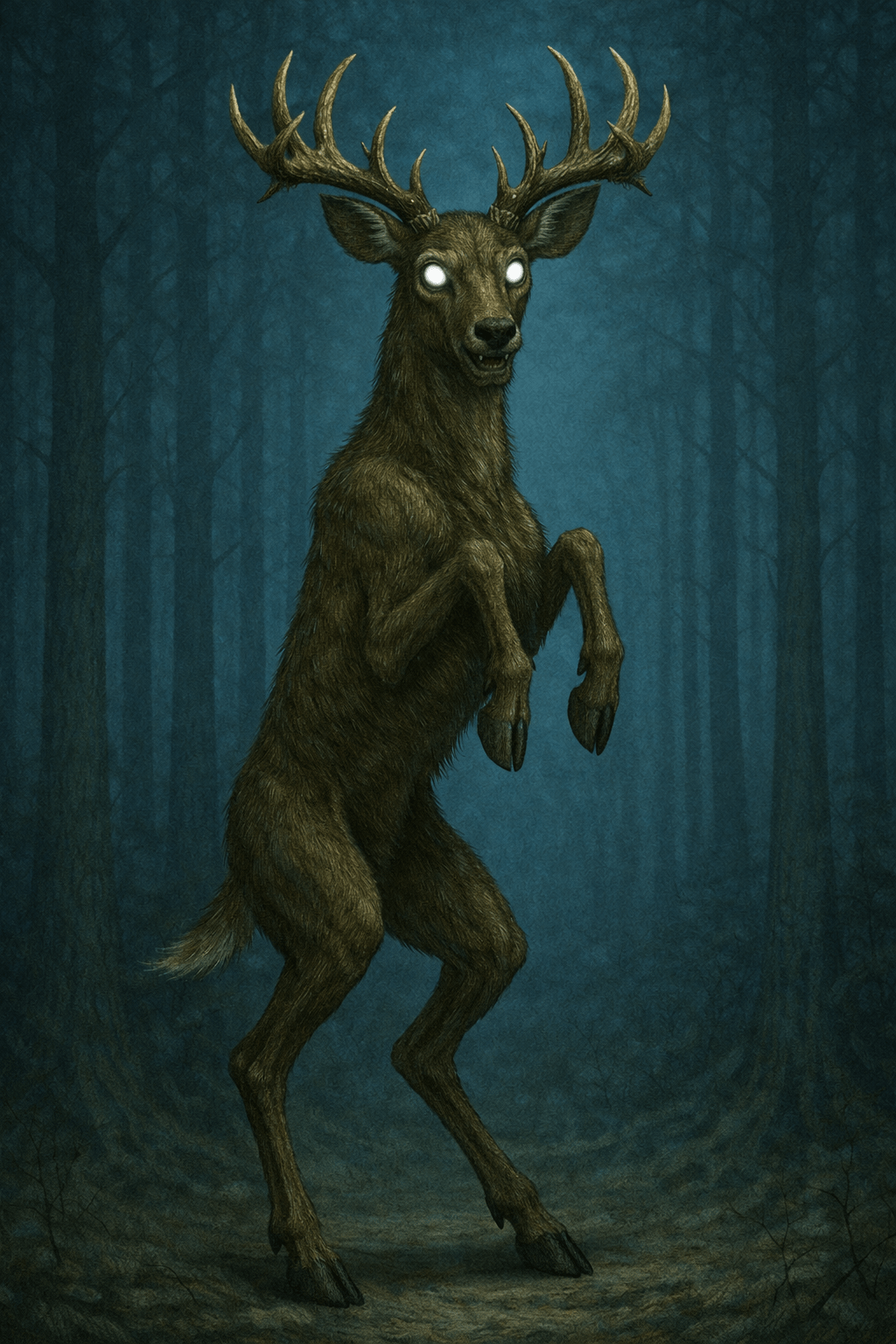
At a distance, the Not-Deer appears to be an ordinary white-tailed deer—graceful, still, almost serene. Closer inspection reveals a collection of errors that the human mind instinctively rejects.
Its proportions are subtly wrong:
- Legs bend at incorrect angles or move out of sequence.
- Joints flex where no joints should exist.
- The neck may be too long, too stiff, or rotate unnaturally.
The face is the most disturbing feature. Eyes are forward-facing rather than lateral, often glowing faintly in low light. The pupils may dilate independently. The mouth, when opened, reveals teeth inconsistent with any known cervid—too many, too human, or arranged for tearing flesh rather than grazing.
Observers frequently report the sensation that the creature is wearing the idea of a deer, rather than being one.
Behavior
The Not-Deer is a patient ambush predator.
It is most often encountered:
- Along forest roads at dusk
- At tree lines bordering rural properties
- Near hunting paths and deer stands
Rather than fleeing from humans, it watches. Prolonged eye contact has been reported to cause disorientation, nausea, and an overwhelming sense of being evaluated—measured.
When threatened or wounded, the Not-Deer does not flee. Instead, it approaches.
Witnesses who survived encounters describe its movement as jerky and imitative, as though it learned locomotion secondhand. Once in pursuit, it displays bursts of speed inconsistent with its size and mass.
Diet
Contrary to its appearance, the Not-Deer is carnivorous.
Confirmed prey includes:
- Small livestock
- Pets
- Lone hunters
- Injured or lost hikers
Evidence suggests the creature is particularly drawn to individuals who are:
- Armed
- Bleeding
- Isolated
Consumption is rarely clean. Remains are often partially eaten, arranged, or left in visible locations—suggesting territorial marking or psychological intimidation.
Habitat
Primarily associated with:
- Appalachia
- Dense Eastern woodlands
- Rural hunting zones
The Not-Deer avoids urban centers but is frequently sighted near roads, suggesting an understanding of human travel patterns. Sightings spike during hunting season.
Origins (Speculative)
The American Beastiary recognizes several competing theories:
- Mimetic Entity Theory
The Not-Deer is not a corrupted deer, but a non-human intelligence that learned its shape by observation—imperfectly. - Punishment Folklore Theory
A manifestation tied to violations of hunting taboos: overhunting, cruelty, or killing for sport rather than need. - Threshold Predator Theory
The creature exists to thin those who cross alone into wilderness spaces believing themselves to be apex predators.
No theory has been conclusively proven.
Defensive Measures
There is no confirmed method of killing a Not-Deer.
Survival recommendations include:
- Do not follow deer that do not flee
- Do not fire a second shot if the first does not drop it
- Avoid eye contact
- Retreat immediately if a deer displays curiosity rather than fear
Hunters are advised:
If it lets you see it—leave.
Notes from the Beastiary
“A deer runs from you.
A Not-Deer waits to see what you’ll do.”
Encounters are underreported due to ridicule, missing persons cases, and the tendency of witnesses to abandon hunting altogether.
 Howlietzer Publishing