Category: FICTION

  • The Harvest Pilgrimage: A New Haven of New Eden Tale

    The Harvest Pilgrimage: A New Haven of New Eden Tale

    High Shepherd Wyatt Hill watched the sunrise from the Holy Hollow Church steps. The early autumn fog clung low to the cobblestones, and the lanterns hanging from the trees burned their last drops of pine-oil before dimming out. Cool mountain air filled his lungs.

    Wyatt took a deep breath and threw his arms out wide, hugging all New Haven.

    “Praise the LORD for this air in my lungs!” he shouted. “Praise the LORD for one more day on HIS creation!”

    His voice boomed across the plaza like a joyful town crier. And then—overcome by delight—he began to dance. The holy vestments swished and rustled around him and his shoes clacked against the cobblestone in a rhythm reminiscent of King David himself.

    The cathedral doors creaked open.

    Mother Superior Edith stepped out just in time to witness the High Shepherd’s enthusiastic display. Her brows lifted.

    “Wyatt Hill,” she sighed, “Is that truly how a High Shepherd should behave?”

    He froze mid-step and flashed her a grin—too wide, stretching a hint past what a human smile should allow.

    “Mother Superior,” he said proudly, “I’m certain that GOD appreciated King David’s bravado as much as mine.”

    “Your true face is showing,” she whispered, tapping his arm. “Remember, this is the Harvest Pilgrimage. Do try not to terrify the children.”

    Wyatt’s features softened, the lingering shadow retreating. His posture sank slightly.

    “I know. I wouldn’t… I—”

    She reached out and hushed him gently.

    “We all changed when we built New Haven,” she said. “Ten years ago, I wouldn’t have dreamed that we could raise anything as magnificent as this in an old holler.”

    Wyatt managed a normal smile this time. “Thank you, Mother Superior.”

    “Call me Edith, Wyatt. I think we can do that,” she said, “Now come along. We have a day’s work ahead. The wagon’s ready, the horses are hitched, and four Watchers are waiting on us.”

    She gestured toward the plaza where a stout wooden wagon sat. Two large horses pawed the ground, their shoes clacking the stone impatiently, and four Watchers stood beside it, their armor gleaming in the sun rise.

    “Marvelous!” said Wyatt. “Shall we?” He offered his arm to escort.

    She gave him a side-eye. “No flirting, Wyatt. You’re wearing the cincture for a reason.”

    “I—I don’t know what you mean,” he stammered.

    “I see your heart, Wyatt,” she said kindly. “Please guard it.”

    His cheeks flushed red as they set off.

    The Pilgrimage Begins

    New Haven radiated outward from the cathedral like a spiderweb—cobblestone roads forming neat rings around the center, then splitting into dirt paths toward fields and forest.

    The harvest pilgrimage consisted of visiting each guild of New Haven and collecting the tithe. Each guild provided ten percent of the income collected from trade, as well as ten percent of the craft, crops, and other goods that the guild master had collected over the year.

    As Wyatt and Edith walked the pilgrimage route, children burst from homes—barefoot, lively, eager to greet the High Shepherd and Mother Superior. The adults waved sleepily from porches, smiling at the early commotion. Wyatt returned greetings with booming enthusiasm, Edith with gentle warmth.

    Their first stop was the Guild of Smiths on St. Joseph Street. The forge glowed like sunrise through the open doorway, sparks leaping like fireflies. The heat, though not unpleasant, pricked against their skin, and the bellows breathed in large bursts.

    Guild Master John emerged, wiping soot from his brow.

    “High Shepherd. Mother Superior.” He nodded, signaling to the Watchers to collect the tithe from the nearby stockroom: polished armor pieces and newly forged weapons, along with other metal works from the smiths of the guild.

    “All awaiting your blessing, High Shepherd,” John said, handing over a heavy coin pouch.

    “Thank you, John,” said Wyatt slipping it into his robes. “How has the work gone? Any blessing or prayers we can make for you?”

    They prayed, spoke briefly, and moved on—stopping next at the Guild of Herbalists, where rosemary and mint scented the air, then at the Guild of Hands, where warm loaves cooled in open windows.

    Each guild greeted them with reverence; each tithe was collected with gratitude.

    Toward the Outskirts

    The cobblestone ended, giving way to soft grass and wide, tilled fields. These were where the Guilds of Keepers and Harvesters dwelled, plenty of space for their animals to graze, and wide enough area for farmers to tend their crops. Vineyards, orchards, fields, New Haven had a cornucopia of produce.

    The Guild of Keepers greeted them next. Guild Master Aaron presented blemish-free animals and the coin tithe from livestock sales. Mother Superior accounted for the animals and sent one Watcher with a couple of Keepers and their dogs to herd the animals back to the Guild of the Veil, where the Sisters would attend to the them.

    It was the Guild of Harvesters, where the pilgrimage met a challenge. Guild Master Theodore stood stiffly outside his guild house, hands clenched.

    Wyatt’s steps slowed. Edith cleared her throat—her subtle signal that something was off.

    “Good morning, Theodore!” Wyatt called. “Is your tithe prepared?”

    Theodore swallowed hard. “Almost. I’ve been waiting for the Talbot family’s portion. They… haven’t submitted anything yet.”

    Wyatt blinked. “Ah, the Talbots. Lovely family—just had their sixth child, I believe.”

    Edith folded her arms, deep in thought.

    “They are new. Only been here a year,” Wyatt murmured.

    The two stood in puzzlement, leaving Theodore at a loss for words. He wrung his hands, not really knowing what to do, and was slightly afraid of the consequences for missing the tithe.

    Edith finally spoke. “Theodore, you know we mean you no harm, but we must speak to the Talbots. This is a holy matter in obedience.”

    Theodore nodded nervously.

    “Cabbages!” said Wyatt, “They’re the cabbage tenders. I remember now. We should visit them at once. Watchers! Carry on with your duty. Our idleness has made the Guild Master anxious. Much to do.”

    He turned to Guild Master Theodore, “Can we pray with you before we head out?”

    At the Talbot Farm

    After the watchers picked up the tithe from the Guild of the Harvest, Wyatt and Edith led the wagon towards the Talbot’s plot. There were several Harvesters in New Haven; each had a small plot and tended a couple different vegetables or an orchard. They were also watchers of the boundary. Though the primary Guild of Watchers kept to the disputes in the city area, Harvesters and Keepers were tasked with maintaining the border defense. Many of which used to belong to United States military before relocating to New Haven.

    Joseph Talbot was a retired captain of the US Airforce. Like many other veterans and service members, he came to New Haven when politics got overwhelming and everyday life got more complicated. His family was a new arrival—only a year in New Haven and he had had his share of problems adjusting.

    He sat slumped on his porch chair, M4 across his lap and dark circles carved deep into his eyes. His wife and children hovered behind him, anxiety exhausting them.

    The cabbages were ravaged. Bite marks. Loose dirt. Joseph had been up all night defending against some jackelopes that had been eating his cabbages.

    He’d been trying to fight them off and stop them, knowing that he had to pay the tithe. But he also had his growing family to worry about, and he wasn’t sure he would be able to feed them and pay the tithe.

    He knew this was one of the many conditions of living in New Haven, and as he fought back sleep that desperately tried to overtake him, he kept watch for any mini-antlered rabbits bounding out of holes and nibbling his remaining cabbages.

    “Hello, Joseph!” shouted Wyatt as he shuffled through the tall grass, Edith and the wagon close behind. “It’s that time of year. Tithing time.”

    Wyatt huffed as he drew closer to the Talbot farmhouse. Mrs. Talbot and the five children, the oldest no older than nine, came out upon hearing his shouts. Their appearance marked with intensity and sleepless eyes.

    “Wyatt,” said Edith. “Let me go on ahead.”

    “What’s wrong?” he asked.

    “Nothing to worry about,” she soothed. “Let me approach first.”

    Wyatt spread his arm out to halt the wagon. He watched Mother Superior greet the Talbots, and then he looked at the cabbages. There seemed to be something amiss. The blessing on this field should have produced a magnificent crop, but there was barely anything left.

    “Lord…”  whispered Wyatt, kneeling in the tall grass, “Give me your eyes to see.”

    The world stilled, and Wyatt’s awareness spread through the farms of New Haven. He felt the scurrying of little paws beneath the soil. The twitch of whiskers. The nervous shuffling of creatures underfoot.

    He smiled, his mouth watering. Tenacious varmints to be wandering this close to New Haven. They’ll make a fine Harvest Day stew.

    Edith returned.

    “Jackelopes,” she said. “The Talbots have been fighting them for weeks. They didn’t say anything because they wanted to prove they could handle it on their own.”

    Wyatt’s eyes glowed white. “Yes… I see.”

    “You already knew,” Edith pouted.

    “The Lord showed me. Your testimony confirmed it. What do you say? Jackelope stew would make a fine addition to the Harvest Day feast.”

    “You’re drooling, High Shepherd,” she smirked.

    “And we can sell the taxidermies to Bob at Jolly Rogers.”

    She covered her mouth and laughed to herself. “The Talbots are awaiting a prayer. The sin of pride has prevented them from participating in the tithes. Joseph was concerned that there would not be enough for his family, and he didn’t want to be a burden on his first year here.”

    “Nonsense!” shouted Wyatt. He marched over to the Talbots. They cowered in their doorway.

    “Joseph Talbot!” Wyatt boomed. “As a part of New Haven, I command you never hesitate to ask for help.”

    Joseph gulped. “I will. Yes, sir. I will ask for help if this happens again.”

    “Guild Master Theodore was concerned for you,” said Wyatt, “but it is not his duty to assume you need any assistance if you don’t ask for it.”

    “Watchers!” Wyatt turned to the three men. “We’re hunting jackelope! Mother Superior, return to Theodore and notify everyone jackelopes are in season.”

    Mother Superior suppressed a laugh as she handed him her handkerchief. “You’re still drooling. I’ll be on my way.”

    The watchers hollered as they grabbed their hunting rifles, ready for a little action.

    The Hunt & Aftermath

    By mid-day, twenty jackelopes lay piled near the wagon, making up the Talbot’s tithe. With the field secure, those who’d came to hunt left to go about their business. Wyatt sat with Joseph on his front porch, eating a cabbage like one eats an apple. The quiet settled heavy between them.

    “Thank you, High Shepherd!” Joseph said. “I didn’t want anyone to think I was dead weight. I wanted to pay my tithe on my own, and I thought if I couldn’t handle this, I’d be kicked out.”

    Wyatt studied him, then smiled warmly.

    “We don’t kick people out. If you didn’t pay the tithe, you would be disciplined, probably just assigned to the mines for a season—but not cast out.”

    Joseph crossed himself as Wyatt took another bite of cabbage, his mouth a bit too wide.

    “Even Theodore struggled his first year. He was a bit surely, but he came around,” said Wyatt, “The Lord’s mercy is wider than the Appalachian Mountains, and as long as you live here, Joseph, you don’t need to carry your burdens alone.”

    Return to Holy Hollow

    Wyatt and Edith returned to Holy Hollow just before dusk, tired but satisfied. They had parted ways with the Watchers after dropping off the tithe with the Guild of Ledgers and strolled back to the church as the lanterns ignited. Peaceful calm in autumn air as snow clouds gathered high. The two made note as the feast would be soon and more preparations followed.

    They had only opened the cathedral doors when Sister Lauren approached.

    “High Shepherd, Mother Superior, the Council of Elders requests your presence immediately. It’s about the Talbots”

    Wyatt sighed. Edith muttered, “Of course it is.”

    The Council of Elders

    They followed Sister Lauren to the Council’s conference room, a side chamber, lit with electric lamps and overhead lights, with a long mahogany table, polished and smooth, and seated around it were twelve elders picked by the church to oversee Holy Hollows affairs and prescribe discipline.

    Upon Wyatt’s entrance he felt their disapproval as he took a seat amongst them. Edith stood behind him, hands on his shoulders in hopes of keeping him calm.

    Elder Gary Pitkannon, an outspoken member of the council, logical, and knowledgeable man of the faith, spoke first. “High Shepherd, we have just been informed that the Talbot family failed to meet their tithe.”

    Wyatt smiled. “Well, you are mistaken. Their tithe was fulfilled. Ten percent of their remaining cabbage was given. Ten percent of their earnings were received. And an offering of twenty jackelopes was accepted.”

    Pitkannon stared at him for a moment. “He has failed to meet the cabbage quota.”

    “We don’t have a quota, Mr. Pitkannon,” said Wyatt, “We have a tithe. And the cabbages were overtaken by jackelopes, which New Haven has remedied. The problem is solved.

    “That’t not the point,” said Elder Miriam Fitsgerald, her voice sharp as a switch. “Tithe disobedience must be met with correction. The punishment is quarry duty.”

    “It’s been taken care of.” Wyatt’s jaw tightened, “Miriam, the man fought all night for weeks to keep the food that he could. Do you not see mercy as a viable path here?”

    Elder Fitsgerald stood up. “That doesn’t negate the law!”

    Wyatt closed his eyes. A familiar voice in the darkness emerged, inviting him to partake in some nostalgia that would never serve the one true GOD. His mind reeled at the temptation to end matters right now. Edith felt the beckoning darkness within him. She squeezed his shoulders, soothing him.

    “If you continue to show leniency, High Shepherd, you risk weakening our authority,” said Elder Pitkannon.

    He’s speaking like a pharisee, Wyatt… The shadow inside him murmured, We don’t put up with those, Wyatt.

    Wyatt took in a deep breath and exhaled. “Holy Spirit, give me the strength to do what is right… and just.”

    The elders stared at him, some curious, some terrified.

    Wyatt opened his eyes. They glowed bright with the Holy Spirit and the darkness subsided within him. “Our authority is nothing without mercy.”

    A tense silence followed.

    Edith backed away quickly as Wyatt rose from his seat. He took another deep breath and exhaled calmly. “I trust the Lord’s guidance more than my temper. I will remove myself before I say, or do, anything ungodly.”

    He bowed politely and stepped out of the room, and shut the door behind him.

    Edith waited one heartbeat.

    Then she faced the elders, her countenance shifting from meekness to foreboding. Her skin glistened silver in the lamp light, her eyes an evergreen as she grew taller than the high ceiling of the opulent room.

    The elders stood up. If they weren’t terrified before, they were now.

    Mother Superior placed her large palm on the mahogany, feeling that elustrious polish, smooth, soft… She raised her arm and split it in half splinters spraying as the elders fell to the floor sobbing.

    When she spoke, her voice carried the weight of mountain stone and wind.

    “Do not mistake Wyatt’s kindness for weakness.”

    The elders recoiled. Elder Pitkannon pushed himself upwards to meet her eyes.

    “You sit in those chairs to shepherd the people of New Haven,” she continued, “not to crack whips over their backs. Mercy is not optional. It is most holy.”

    Elder Pitkannon bristled. “Mother Superior, your place…”

    “My place is to guard this flock, even if that means guarding it from you!” Her eyes bore holes into him. “Know your place!”

    The power flickered and the room temperature dipped suddenly, sending shivers down the elder’s spines.

    Edith sighed. “Look what you made me do?”

    She shrunk back to normal size. “I’ll make sure a new table to brough in here as soon as possible. And I hope none of you forgot to pay your tithe. The Ledgerkeepers will inform me if you have not.”

    The End?

    Wyatt retreated to his office to brood. He found solace in the wall he had of pictures that the children drew of him. It helped fight the darkness.

    He was smiling at one in particular when there was a knock at his door.

    “Please, come in,” he said.

    Edith slid through the door, a bit disheveled but radiated her usual calm demeanor.

    “How bad was it?” Wyatt asked.

    She stood next to them. “Handled. I think I put the fear of God back into them.”

    Wyatt breathed out a quiet laugh. “Oh, my! You scare me more than the Lord does sometimes, Edith.”

    She nudged him with her shoulder. “Good. Someone has to. Oh, and I promised them a new table.”

    “What?”

  • I’m Not for Dinner – A Terrifying Not Deer Horror Story

    I’m Not for Dinner – A Terrifying Not Deer Horror Story

    I’m Not for Dinner: A Not Deer Horror Story

    Darren Hilderoy pulled into an empty parking spot at the Smoky Mountain National Park. Surprisingly, the lot wasn’t as full as he’d expected, considering it was the first day of deer season. Only a couple of pickup trucks, including his, dotted the large parking area. It was remarkable since he’d scoped out his spot months in advance and believed it was a diamond in the rough.

    For most of Darren’s life, he’d gone deer hunting with his dad. At age 13, he’d killed a 6-point buck. He never forgot; his dad beamed at him for days. It was the best moment of his life… Now, Darren had retired from the Marines and just came back from active duty to find his father wasn’t in the best of shape. Hunting was simply out of the question for someone at his age.

    It hurt Darren to go hunting without his dad, even though he’d been serving overseas off and on during his career; he had not had the opportunity to share this pastime with his father for a long time and would never again.

    He sighed as he zipped up his coat. Almost Christmas time, he thought. Maybe he could find a nice buck to share with his dad. Though he wouldn’t be with him, Darren knew he would enjoy seeing a picture. He wasn’t sure about reception on his cell phone, but he could always show him at Christmas. He would definitely share a portion of the butchered deer with his mom and dad.

    He started salivating over his mother’s venison stew. That really hit the spot in cold December. He pulled his rifle out of the back seat and strapped his bowie knife simply out of habit, the same as slipping on his dog tags every morning. He also made sure he brought his field dressing kit for the kill. Venison stew still danced in his head.

    He would have to be extra careful; he hadn’t field-dressed anything in a long time. He sure didn’t want the intestines spilling feces all over the place. He took the path to his tree stand and once there, ascended. There was nothing like the cool mountain air high in a tree. He surveyed the area and sighed. Beautiful country. Even if nothing came into his sights, it was peaceful and quiet.

    He took out his binoculars and scanned the area. Nothing yet. Hunting took a lot of patience. Something his father failed to teach him, but the Marines managed to beat into him. Every shot counted, and you didn’t want to shoot unless you were ready to kill.

    Several hours later, Darren found what he was looking for: a 6-point buck had wandered into a clearing. He smiled and readied himself. The quiet was deafening as he scoped the beast, exhaled, and squeezed the trigger. The animal ran off. But he was sure he hit it! He’d seen the impact; it should have dropped right there.

    Instead, it ran off like nothing hit it. He followed it with his sight. It was wounded; it limped a little as it bounded. It would fall soon. Though it wasn’t a clean shot, apparently, the deer would fall. He just had to follow it now.

    He climbed out of the tree stand and followed the blood trail. The deer had taken a winding path deep in the woods, bleeding on the bushes and sides of trees. It’s erratic and staggering prints bewildered Darren. He knew he hit it. He was certain it was a fatal shot, but the trail pulled him further away from his stand than he felt comfortable.

    In all his years, he’d never had to hike this far to find his kill. He didn’t know if it was his mind, narrowly focused on retrieving the deer, or if the forest itself silenced. He scarcely heard a cricket in the dusk, and the shadows of night flickered in his blind spots, darting behind trees, close by but never in direct eyesight, like something tracking him. He felt like he was prey.

    The air was thick with some foreboding force, like a pack of wolves had surrounded him. The shadows carried a new paranoia with them; he couldn’t help but imagine voices behind every tree, shifting shapes darting between every tilt and turn of his head, and he was about to turn back.

    The sinking feeling in his stomach was getting to him badly, but then he finally found it, lying against a tree, still and breathless. His confidence returned as he retrieved his field kit. He positioned the animal and prepared his tools, remembering that he had to be careful not to puncture the organs.

    He couldn’t shake it now; he felt like the woods had passed judgment upon him. And something else felt off about this deer. He couldn’t put his finger on it. There was something wrong with its face. In the darkness, he couldn’t be sure, but as he was now up close to the creature. It looked remarkably dog-like and at the same time human. It also didn’t smell right.

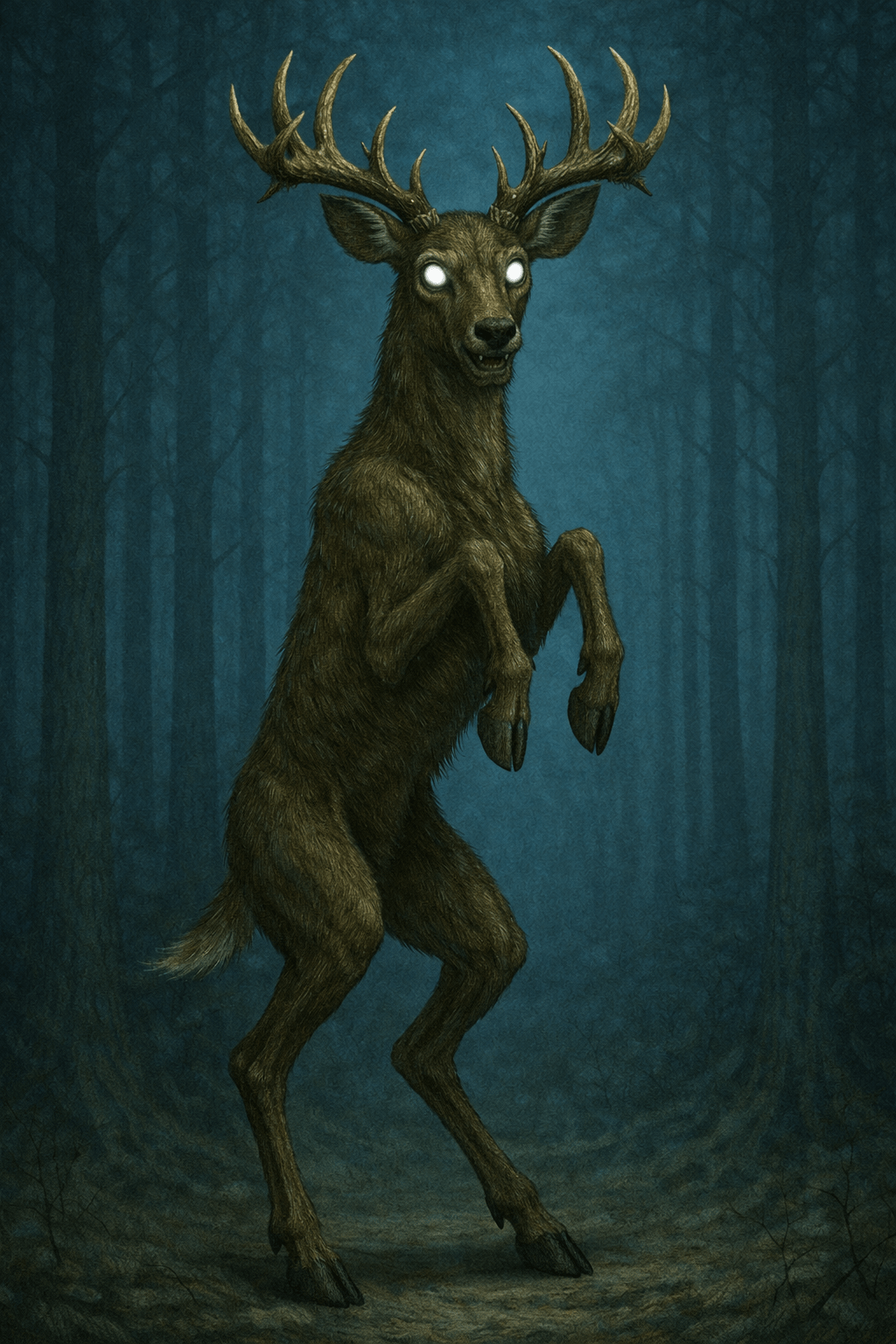
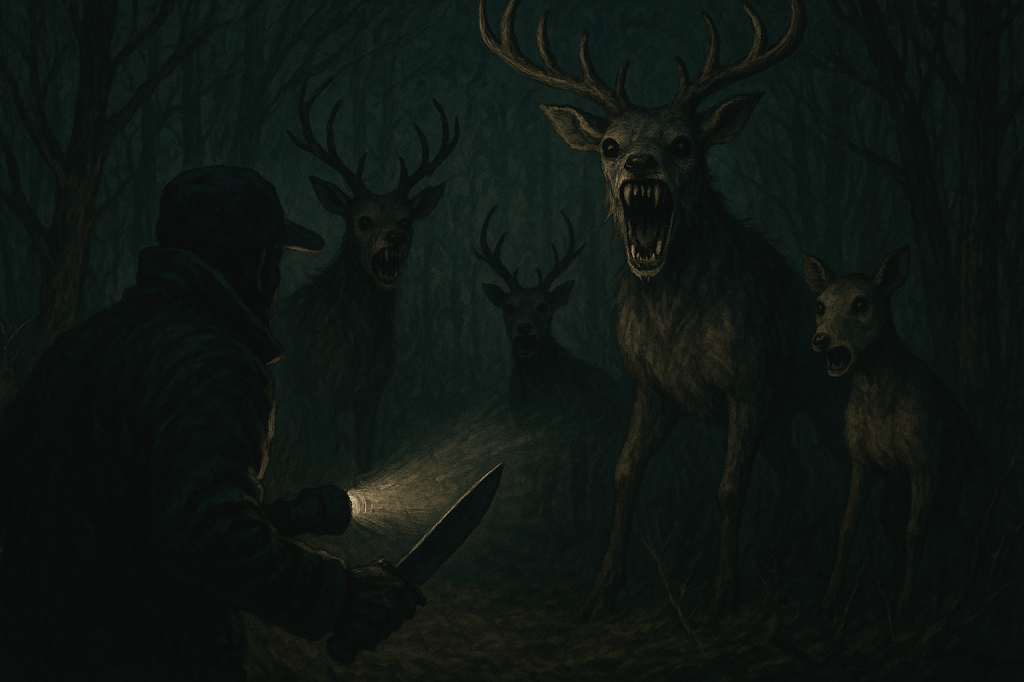
    There was the acrid wet dog smell that came off its fur like a musk. He jumped as he heard a series of grunts and barks. They sounded like deer, several deer all around him. He shone his flashlight, and out from the trees stepped deer, all on two legs, mouths open wide with lots of sharp teeth.

    The one that he thought he’d killed also leapt from its place and attempted to pounce on him, its fore hooves resembling a mashup of dog and human digits—capable of grasping, but with long hoof-like nails.

    Darren dodged and gripped his field dressing knives in a defensive stance as five of these monster deer approached and circled him. The six-point that he shot had joined the circle of barking, grunting, bleating monsters; none had gotten any closer, and then an eight-point broke the circle, snarling and drooling. It appeared to be the alpha, and they all looked very hungry.

    They sized each other up. Darren couldn’t hesitate. He’d already let them get too close. He needed to find his exit.

    He eyed each one. A doe behind him was smaller than the rest. That was his exit.

    He bolted towards it, knives out, cutting as he pounced upon her. The others leapt after him as he’d knocked her down and sprinted past them.

    They were hot on his trail, their barks loud and ferocious, cutting through his nerves, but he kept running. One reached him, the six-point, digging his hoof fingers into his large coat. Darren slashed at the beast while also discarding the downy warmth of his coat. His rifle fell with it, and the monster jumped upon it.

    Darren just kept running.

    He made it all the way back to his truck before he realized his keys were in his coat pocket.

    He cursed as he looked over his shoulder to see them at the edge of the woods. If he had his rifle, things might have been different, but as he remembered, the six-point survived what should have been a fatal shot.

    They sniffed the air and barked at each other; the eight-point took the lead. They did not seem to be able to see very well, mostly relying on smell. He checked his truck door one last time: locked. He wasn’t getting inside.

    He scanned the area, always keeping one eye on the pack. Again, they did not seem to have a direct lock on his position, but they were getting closer; he could not lollygag any longer. He ducked behind his truck and started looking for a solution.

    The lot was empty now, except one other vehicle. He crawled towards it, rattled by the monster’s barking. Once he got to the driver’s side, he tried to open the door. Locked! But as he peered into the back seat, he saw a gun case.

    He broke the window with the butt of his bowie and reached inside. He pulled out the case and unfastened the latches. He was so lucky there wasn’t a lock on the case, nor the weapon… He had mixed feelings about that, but he had to find ammo. Inside the case for this AR-15, there were three fully loaded 30-round mags…

    This person is truly irresponsible but thank God they left this here!

    Darren pulled the bolt back, loaded the magazine, and brought the bolt forward. His Marine training kicked back in.

    From behind the vehicle, Darren lined up his shot. If a center mass shot was not enough, he was aiming for the head. Maybe zombie rules were in place here… What was he thinking?

    Regardless, he aimed for the closest one that stopped to sniff the air, and with his next exhale, squeezed the trigger, felling the beast. He hit the head this time. That was the trick.

    The beast perked their ears and looked in his direction, but they still didn’t seem to have a good bead on where he was. He took aim at the next one, and it fell. Then the next. Then the eight-point was right in front of him, the vehicle was their only separation.

    It jumped… high! Right over the vehicle and right behind him. Darren turned quickly enough, instinctively grabbed his bowie, and plunged it into the creature.

    It shrieked, alerting the others, and then slashed at Darren’s stomach with its fingers. Darren dodged by a breath, pinning himself to the vehicle as the eight-point fell to its knees and clawed at the knife. Quickly, Darren raised the gun to the monster’s head and shot it dead.

    The leftover, one doe, stood frozen. Darren saw it as he slowly turned around. It seemed to be very aware that its family was dead, but it also seemed to be at a loss as to what to do now. Darren raised the rifle and killed it.

  • The Line – A Spoken Word Descent into Madness

    The Line – A Spoken Word Descent into Madness

    I’ve done some wild things inside my head.

    I’m not much of a talker–quiet type, really. I like to watch. Observe. Pick apart the patterns in people, in moments, in memories. I don’t always find something worth analyzing, though. And on those days, I go deeper. Inward. Looking for something else. Secrets. Mechanisms. Truths.

    One time, I went searching for an off switch–just to see if my brain had one. I found it. It looked like a lever, tucked away in a quiet corner of myself. Being the curious sort, I flipped it.

    Everything started shutting down. My thoughts dulled. A heavy fog rolled in behind my eyes. I felt like I was slipping into the deepest sleep imaginable. And then… I stopped breathing.

    Panic hit like lightning. I clawed my way back to the lever and yanked it hard to ON.

    Air rushed back into my lungs like floodwaters. I gasped. Trembled. Adrenaline surged through me like fire. I’d never felt so alive–and so close to not being alive. I never pulled that lever again.

    But that wasn’t the only time I wandered too deep.

    There was another place. A darker place. A corridor in my mind with no lights, no sound–just a presence. And there, etched like a scar into the mental floorboards, was a line.

    I knew what it was the moment I saw it. No signs. No warnings. You just know. It was the threshold between sanity and madness.

    There was a voice on the other side, faint but seductive. It beckoned. “Come see for yourself.”

    And so, like a fool chasing forbidden knowledge, I crossed the line.

    I ran headfirst into the abyss.

    The screams were the first to greet me–children’s screams, full of panic, pleading, pain. Sounds I pray to forget. Then came the visions: twisted, unholy, splattered in crimson. The laughter–mine–wasn’t mine at all. It was fractured. Crooked.

    I felt teeth in my mouth that didn’t belong to me. Felt the hunger. The thrill of violence. I saw myself smiling, wide and unnatural, as I tore and devoured and destroyed.

    But something in me resisted.

    I turned and ran. Hard. Blindly. Toward the line, praying it was still there.

    When I crossed back, the silence was deafening. The relief… indescribable.

    I never looked back.

    I don’t want to know what happens if you stay on the other side too long.

    I never searched for the line again.

    I never will.

  • The Driving Game – A Deadly Late-Night Horror Story

    The Driving Game – A Deadly Late-Night Horror Story

    No one knows who created the game. Maybe it started when the first cars rolled off the lot and took to the open road. Whoever invented it probably didn’t see this coming—or intend for it to end like this.

    Harold Pfinster and his friends called it the game. It was simple. On any two-lane road, Driver A would pull up beside Driver B and drive alongside them, matching their speed. The goal was to make Driver B uncomfortable—force them to either speed up or slow down. When they did, Driver A would adjust accordingly, keeping pace. The fun was in the subtle pressure, in not letting the other car get away.

    Harold liked to say he invented the game. No one he knew had heard of it before he started doing it, and his friends were surprised—and thrilled—when he taught it to them. It was fun, harmless, stupid fun.

    Until one Friday night.

    Harold and his three friends were out driving late, bored and restless. Their small town didn’t have anything cool for teens to do. At seventeen, eager for something more than sidewalks and gas stations, they were always looking for adventure.

    “We could walk around Walmart again,” one of them said, without enthusiasm.

    Harold, dark-haired and sharp-eyed, leaned back in the driver’s seat and looked into the rearview mirror. “Nah, man. That shit’s old. Why is there never anything to do around here?”

    “Why don’t we just go to my place and hang out?” another offered. “This is getting boring.”

    “I know,” Harold said with a sigh. “I just want to do something, you know? I wish there was a teen nightclub or something.”

    “Yeah,” the third friend chimed in, “one that served beer to minors.”

    “I’ve got beer at my place,” said the second friend. “My parents won’t notice.”

    “Alright,” Harold said, turning onto the highway. “Guess I’m done.”

    He picked up speed as they approached the turn—then slammed the brakes.

    A black Ford Focus was crawling in front of them. Its windows were so tinted Harold wondered how the driver could even see out. And why the hell were they going 30 in a 55?

    He laid on the horn. “Damn it! What is this guy doing?”

    “Probably lost,” one friend guessed.

    “Wish he’d get lost somewhere else,” Harold muttered.

    He pulled into the other lane, ready to pass—when the second friend spoke up.

    “Wait, Harold. Let’s play the game.”

    “Yeah,” said the third, excited.

    Harold smirked. “Alright, you guys. But it’s gonna be a long night if this guy’s really this slow.”

    He dropped his speed to 30 and matched the Ford’s pace. The road was empty—flat, straight, and perfect for games… or speed traps. But no cops in sight.

    The Ford sped up to 55.

    Harold adjusted immediately. Still side by side.

    Then it sped up more.

    “Oh, this guy’s gonna be fun,” Harold grinned.

    “Don’t lose him,” said the first friend.

    Harold didn’t.

    The two cars danced the road together, speeding up, slowing down, until finally the Ford settled at the speed limit.

    “Alright,” Harold said, relaxing. “That was fun. Let’s get out of here.”

    He eased up on the gas, ready to slip behind the Ford.

    But the Ford slowed down too.

    “Oh,” Harold said, unfazed, “He still wants to play.”

    So they kept going. But the fun started to fade. It was getting late.

    “Come on, Harold,” said the third friend. “Give it up already.”

    “He won’t leave us alone. I’m starting to get worried.”

    “Hey,” said the second friend in the passenger seat. “He’s rolling his window down.”

    The friend rolled his down too, leaning out to get a look at the driver.

    Then—bang—a burst of light and sound.

    A bullet tore through the passenger’s skull.

    “Shit!” Harold screamed, swerving wildly as the friend’s brains sprayed across the interior. The car lurched, hit the Ford, and skidded off the road.

    They slammed into the ditch and flipped onto their side.

    Harold unclipped his seatbelt and shoved open the door. “You guys okay back there?” he called, his voice shaking.

    “Yeah,” they answered, trembling. “But what about—”

    “Don’t worry about him,” Harold said, already looking outside. “That guy… he’s coming over.”

    The Ford was parked now. Its driver—a man in black, face masked—was walking toward them. A pistol dangled casually from his right hand.

    “Oh, shit!” Harold scrambled out, trying to run.

    Bang.

    “Angh!” he collapsed, a searing pain in his leg. The man had shot him.

    Friend One opened the back door to look out.

    Bang.

    He fell onto Friend Three, who screamed as he was shoved against the car door.

    Harold rolled onto his back and watched, helpless, as the man stepped closer.

    Bang.

    Another shot into the back seat.

    Everyone else was dead.

    The man stood over Harold now. All Harold could see were his eyes—grey, cold, expressionless.

    He moved with precision. Military. Calm. Professional.

    Then he pulled down his mask.

    “I won,” he said.

    He raised the gun and pulled the trigger.