Author: Mr. Howlietzer

  • Not-Deer

    Not-Deer

    American Beastiary Entry: The Not-Deer

    Common Name: Not-Deer
    Other Names: The Wrong Buck, Hollow Stag, Skinwalker Deer, The Watching Herd
    Classification: Mimetic Predator / Appalachian Cryptid
    Threat Level: Extreme
    Status: Active, Uncontained


    Description

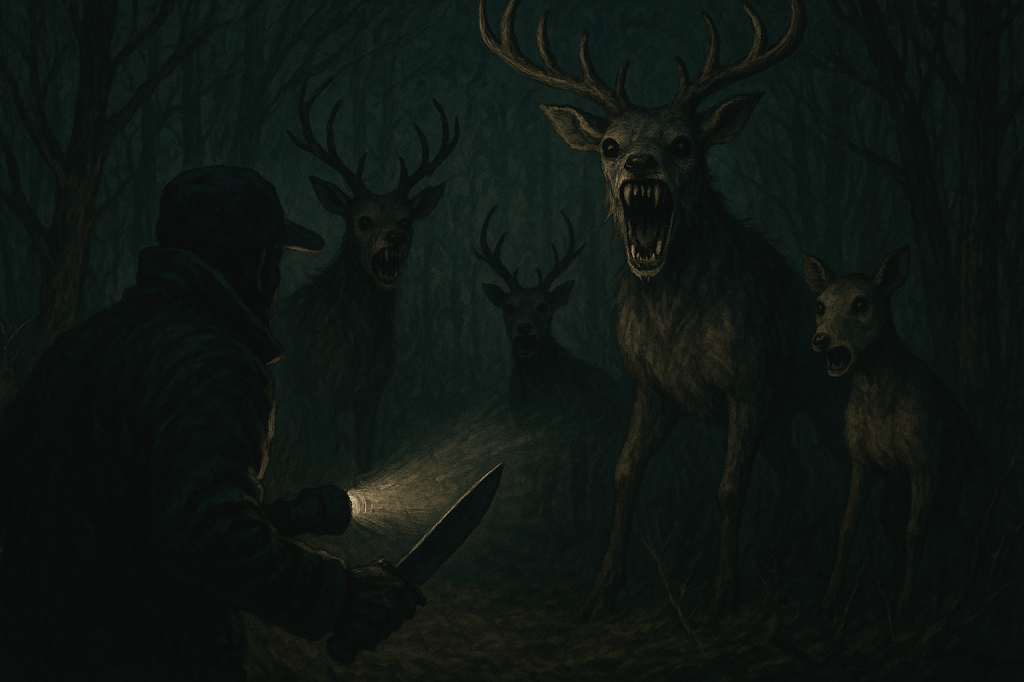
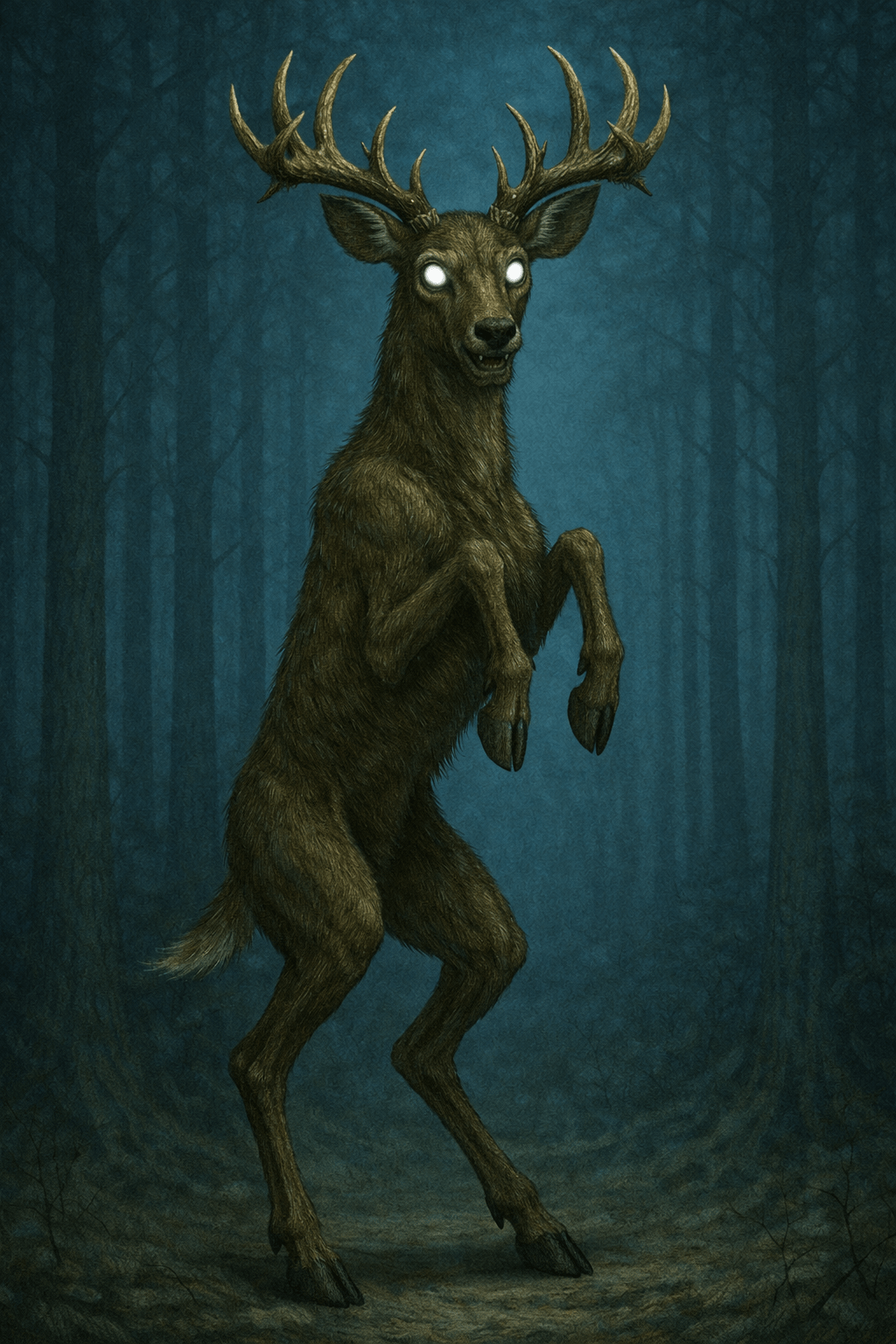
    At a distance, the Not-Deer appears to be an ordinary white-tailed deer—graceful, still, almost serene. Closer inspection reveals a collection of errors that the human mind instinctively rejects.

    Its proportions are subtly wrong:

    • Legs bend at incorrect angles or move out of sequence.
    • Joints flex where no joints should exist.
    • The neck may be too long, too stiff, or rotate unnaturally.

    The face is the most disturbing feature. Eyes are forward-facing rather than lateral, often glowing faintly in low light. The pupils may dilate independently. The mouth, when opened, reveals teeth inconsistent with any known cervid—too many, too human, or arranged for tearing flesh rather than grazing.

    Observers frequently report the sensation that the creature is wearing the idea of a deer, rather than being one.


    Behavior

    The Not-Deer is a patient ambush predator.

    It is most often encountered:

    • Along forest roads at dusk
    • At tree lines bordering rural properties
    • Near hunting paths and deer stands

    Rather than fleeing from humans, it watches. Prolonged eye contact has been reported to cause disorientation, nausea, and an overwhelming sense of being evaluated—measured.

    When threatened or wounded, the Not-Deer does not flee. Instead, it approaches.

    Witnesses who survived encounters describe its movement as jerky and imitative, as though it learned locomotion secondhand. Once in pursuit, it displays bursts of speed inconsistent with its size and mass.


    Diet

    Contrary to its appearance, the Not-Deer is carnivorous.

    Confirmed prey includes:

    • Small livestock
    • Pets
    • Lone hunters
    • Injured or lost hikers

    Evidence suggests the creature is particularly drawn to individuals who are:

    • Armed
    • Bleeding
    • Isolated

    Consumption is rarely clean. Remains are often partially eaten, arranged, or left in visible locations—suggesting territorial marking or psychological intimidation.


    Habitat

    Primarily associated with:

    • Appalachia
    • Dense Eastern woodlands
    • Rural hunting zones

    The Not-Deer avoids urban centers but is frequently sighted near roads, suggesting an understanding of human travel patterns. Sightings spike during hunting season.


    Origins (Speculative)

    The American Beastiary recognizes several competing theories:

    1. Mimetic Entity Theory
      The Not-Deer is not a corrupted deer, but a non-human intelligence that learned its shape by observation—imperfectly.
    2. Punishment Folklore Theory
      A manifestation tied to violations of hunting taboos: overhunting, cruelty, or killing for sport rather than need.
    3. Threshold Predator Theory
      The creature exists to thin those who cross alone into wilderness spaces believing themselves to be apex predators.

    No theory has been conclusively proven.


    Defensive Measures

    There is no confirmed method of killing a Not-Deer.

    Survival recommendations include:

    • Do not follow deer that do not flee
    • Do not fire a second shot if the first does not drop it
    • Avoid eye contact
    • Retreat immediately if a deer displays curiosity rather than fear

    Hunters are advised:

    If it lets you see it—leave.


    Notes from the Beastiary

    “A deer runs from you.
    A Not-Deer waits to see what you’ll do.”

    Encounters are underreported due to ridicule, missing persons cases, and the tendency of witnesses to abandon hunting altogether.

  • Northern Owlcat

    Northern Owlcat

    THE NORTHERN OWLCAT

    Strix rufus glacialis — “The Ghost of the Pinewoods”
    Classification: Mid-Size Chimeroid Predator
    Habitat: Boreal forests, high Appalachian ridges, northern Rockies, subarctic pine belts
    Temperament: Silent, elusive, fiercely territorial


    Physical Description

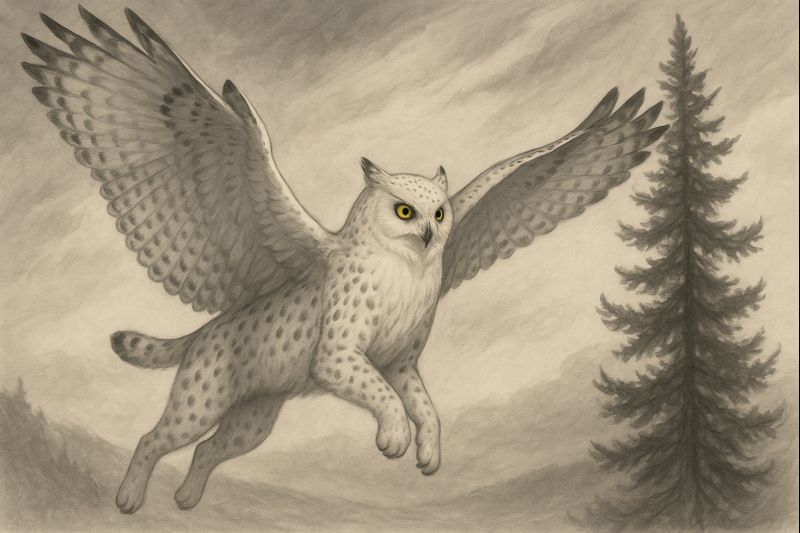
    The Northern Owlcat is a compact yet formidable hybrid of snowy owl and bobcat, built for survival in cold, forested environments. Its form is a seamless fusion of feather and fur, lending it an almost supernatural ability to blend into snowy undergrowth or moonlit branches.

    Distinct Features

    • Head: Rounded and feathered like a snowy owl, with piercing yellow eyes capable of seeing through blizzard conditions. Small, sharp-tipped ear tufts mimic a lynx’s silhouette.
    • Wings: Long, broad, and silent—snowy owl wings engineered for stealth flight. When fully extended, they span nearly twice the creature’s body length.
    • Body: Compact and muscular, covered in dense white fur marked with charcoal-gray bobcat spots. This coat provides insulation and camouflage in snow-blanketed forests.
    • Tail: Short and bobbed, with a dark tip—perfect for maneuvering through pine branches without noise.
    • Feet: Forepaws feathered and tipped with curved talons, a deadly combination of bobcat strength and raptor precision.

    Standing only twenty to twenty-four inches at the shoulder, it is smaller than a typical griffin-type, but do not mistake its size for harmlessness.


    Behavior and Abilities

    The Silent Glide

    The Owlcat’s most iconic behavior is its method of hunting:
    From a pine branch high above, it spreads its great wings and enters a near-motionless glide, descending toward prey with total silence. Its wing feathers absorb sound, while its bobcat musculature allows for sudden mid-air changes in direction.

    This gliding attack is the origin of many local legends describing
    “a ghost drifting down from the treetops.”

    Winter Camouflage

    Its snowy coat and spotted markings break up its silhouette, even while in motion. Under fresh snowfall, an Owlcat can remain invisible until the moment it pounces.

    Territorial Intelligence

    The species is solitary except during winter pairing season. Each Owlcat maintains a radius of forest claimed through:

    • Scratched markings on trees
    • Talon grooves on boulders
    • Hanging owl-like pellets containing fur and bone

    Trespassing animals are chased away with shrill, owl-like shrieks—far louder than their size would suggest.

    Diet

    They prey on:

    • Snowshoe hares
    • Mink
    • Grouse
    • Small deer fawns
    • Occasionally, raccoons or fox kits

    When food is scarce, they glide-fish along frozen riverbanks, plunging through thin ice with spear-like talons.


    Habitat and Range

    Northern Owlcats thrive in:

    • Deep boreal forests of Canada
    • Upper Great Lakes wilderness
    • Northern Rockies
    • High elevations of the Appalachians (rare and disputed)

    They prefer old-growth pine and fir where thick branches provide launch points for gliding.


    Cultural Significance

    Several First Nations tribes associate the Owlcat with:

    • Shapeshifters
    • Dream-walkers
    • Forest guardians

    Because of its silent nature and bright yellow eyes, it is often called “The Lantern in the Snow.”

    European settlers recorded sightings as early as the 1700s, typically describing it as:

    “A white forest cat with owl wings descending like a specter.”

    Modern cryptid researchers classify it as one of the Subarctic Chimera Forms, related to but distinct from the larger American Griffin.


    Threat Level

    Moderate.
    The Northern Owlcat avoids humans and rarely attacks unless:

    • It is cornered
    • Its nesting grounds are disturbed
    • Hunger drives it to desperation during deep winter

    When forced to fight, it unleashes a terrifying mix of aerial dives, slashing talons, and disorienting owl shrieks.

    Most hikers who report encounters describe hearing nothing at all—until it’s already landing nearby.

  • American Griffin

    American Griffin

    THE AMERICAN GRIFFIN

    Haliaetus pumae — “The Eagle-Lion of the New World”
    Classification: Apex Chimeroid
    Habitat: Rocky Mountains, Yellowstone Plateau, Sierra Nevada
    Temperament: Noble, territorial, calculating


    Physical Description

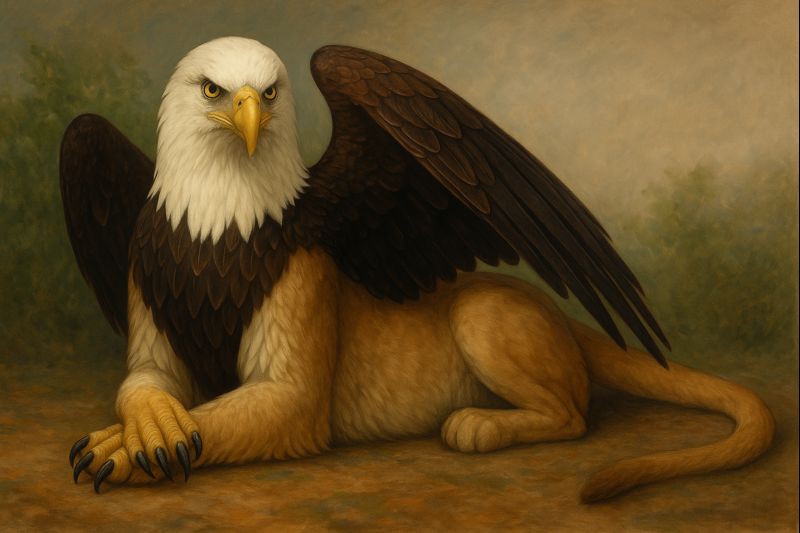
    The American Griffin is a hybrid beast formed from the union of two of North America’s most revered predators: the bald eagle and the mountain lion. Sleek and powerfully built, this griffin carries the regal intensity of an eagle and the silent strength of a big cat.

    Its head and chest are covered in immaculate white feathers that transition into deep brown along its shoulders and wings. The breast feathers extend down its torso, tapering into short plumage that merges naturally with tawny mountain lion fur.

    The forelimbs are unmistakably raptorial — golden scaled arms ending in curved black talons designed for crushing bone and gripping sheer cliff faces. The hindquarters resemble a lean mountain lion, long and muscular, bred for stealth and power. Its tail, unlike the tufted tail of the Old World lion, is a long, expressive mountain-lion tail used for balance during aerial maneuvers.

    Most specimens measure around nine feet from beak to tail, with wingspans exceeding fourteen feet.

    When resting, the American Griffin often lies with forelimbs crossed, wings partially open — a posture that appears regal and contemplative, yet ready to explode into motion at any moment.


    Behavior and Abilities

    Aerial Hunter of the High Country

    The American Griffin is one of the few creatures capable of predatory flight at high altitudes. Its eagle half grants unmatched eyesight: it can identify a moving object the size of a rabbit from over a mile away.

    In the air, it combines:

    • Eagle stooping speed (up to 120 mph)
    • Mountain lion agility, able to twist or bank with unnerving precision
    • A silent glide that precedes most of its ambushes

    Territorial Intelligence

    Unlike the more chaotic American Chimaera, the American Griffin is highly intelligent and exhibits:

    • Complex territorial boundaries
    • Long-term nesting sites
    • Cooperative hunting when raising young

    It is fiercely loyal to mates and offsprings, forming small familial prides known as echelon clutches.

    Combat and Defense

    When threatened, the griffin employs:

    • A thunderous wing-beat capable of knocking a grown elk off balance
    • A razor-precise beak strike, often fatal
    • Talon grapples that immobilize prey instantly

    Though naturally noble and stoic, a cornered American Griffin becomes a whirlwind of talons and feathers.


    Habitat and Range

    Sightings most commonly occur in:

    • High cliffs of the Rocky Mountains
    • Pine forests around Yellowstone
    • Alpine ridges of the Sierra Nevada
    • Rare, disputed sightings in the high Appalachians

    They build nests — called eires — the size of small cars, constructed from fallen logs and bones of previous kills.


    Cultural Significance

    Among North American tribes, the griffin symbolizes:

    • Watchfulness
    • Protection
    • Divine justice from the mountains

    Early pioneers believed spotting one was a sign of fortune on long journeys… unless it circled overhead more than twice, which was considered a dire omen.

    Modern cryptid researchers classify it as one of the “High Clade Guardians,” alongside the Thunderbird and the Iron Elk.


    Threat Level

    High, but avoidable.
    American Griffins seldom attack humans unless:

    • Their nest is threatened
    • They are wounded
    • A traveler is mistaken for a rival predator

    If spotted resting with wings half-open, it is not an invitation — it is a warning.

  • American Chimaera

    American Chimaera

    American Chimaera

    Habitat: Rocky Mountains, Appalachian Range
    Classification: Apex Hybrid Predator

    Description:
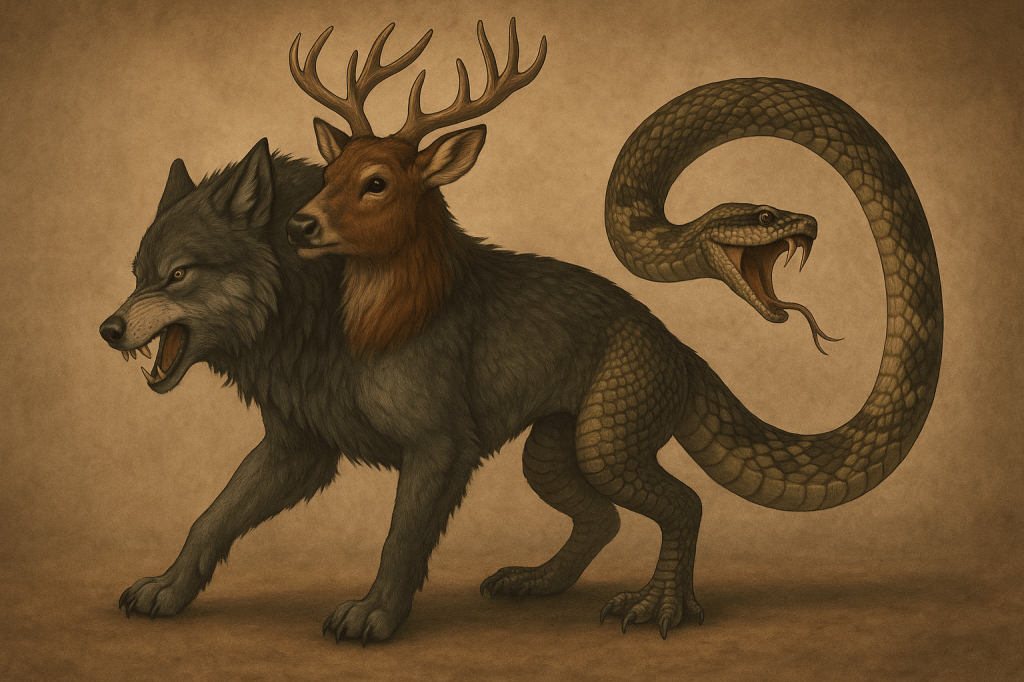
    The American Chimaera is a rare and formidable apex predator said to have been born from the continent’s primal wilderness itself. Its body resembles that of a dire wolf — broad-shouldered, sinewy, and built for both endurance and ambush. Two heads crown its form: one of a wolf, the other of a stag. The wolf symbolizes predation and instinct, while the stag embodies vigilance and sovereignty. From its tail grows a diamondback rattlesnake, ever poised to strike, its venom rumored to paralyze even a bear within seconds.

    Behavior:
    Unlike its Greek cousin, the American Chimaera does not breathe fire; instead, it rules through stealth and cunning. It is said to prowl during storms, when thunder masks its movements. Witnesses claim the sound of distant rattling in the wind heralds its approach. Each head serves a distinct function — the wolf hunts, the stag senses danger, and the serpent defends the rear.

    Myth & Legend:
    Native legends speak of the creature as the Spirit of Balance — a manifestation of nature’s duality, both predator and protector. Appalachian folk tales, however, call it The Backwoods Devil, a beast that punishes greed and trespass. In the Rockies, miners once left offerings of tobacco and whiskey to keep its gaze from their camps.

    Habitat & Diet:
    Solitary by nature, the Chimaera roams vast territories stretching from the shadowed hollows of West Virginia to the snow-laced slopes of Colorado. It preys on elk, wolves, and occasionally unwary humans.

  • Welcome to Jolly Rogers, Where We Got the Booty

    Welcome to Jolly Rogers, Where We Got the Booty

    Part 1

    “Do you like good food? Do you like out-of-this-world novelty items?”
    Bob, dressed in a cheap pirate costume, grinned at the camera, delivering his lines for the latest Jolly Rogers ad.

    Behind him, a spread of food steamed under heat lamps—brisket, ribs, sausages, cornbread, sandwiches. Racks of shirts, jeans, and hoodies showed off the smiling skull logo. Aisles glittered with toys and bizarre roadside trinkets.

    “Then come on down to Jolly Rogers, where we got the booty… Guys…”

    “Cut!”
    Sean stepped in front of the camera and grabbed Bob’s shoulders. “Bob. Just say the line. You’ve said it a hundred times. This isn’t hard.”

    “The line is dumb,” Bob said, ripping off his eye patch. “We need to go back to the drawing board. I mean, seriously.”

    “No, no, no,” Sean scolded. “We are not doing makeup again. We’re already behind schedule. And Tyler—stop dancing! You look like a broken Chuck E. Cheese animatronic.”

    Tyler, fully suited in the Jolly Rogers mascot costume, continued to robot dance, oblivious.

    “Tyler!” everyone shouted. Still no reaction.

    Sean marched over and yanked off the oversized mascot head. “Tyler, earbuds out. You can’t hear anything with the head on, let alone with those in.”

    Tyler blinked. “Are we done?”

    Bob joined them. “All I’m saying is—since we have a new captain—maybe we can try something different?”

    “Don’t get me started on that ‘new captain’ crap,” Sean snapped. “It’s ‘Jolly Rogers: We got the Booty!’ That’s the slogan. Always has been.”

    “Bit problematic, don’t you think?” Bob said, rubbing at his fake mustache. “We could workshop something—”

    “And while we’re at it,” Sean said, “you should’ve been Captain, Bob. Even Wade would have been better over Mark.”

    Bob raised a brow. “Now that’s improbable.”

    Tyler adjusted his suit uncomfortably, suddenly invisible again.

    “You were there, Bob,” Tyler said, hesitantly. “Why’d the Captain allow it?”

    Bob checked his novelty Jolly Rogers wristwatch. “We’re behind. Let’s wrap it up. Black Friday’s coming fast, and we’re not ready.”

    He called to the crew, “Wrap it up, folks! Doors open soon. And remember—no robbing the customers. We voted on that.”

    “They should chain their wallets if they care so much,” Sean muttered, breaking down the lights.


    At 6’4”, Bob towered over most. He lumbered back into his office at the rear of the store. With the crew filming done and the floor staff in place, it was time for paperwork.

    Before the new captain took over, Jolly Rogers had been nothing but stolen goods—except what they traded for with New Haven. All the food came from trade. Everything else was snatched from wayward vehicles.

    Raids were easy. Something about the region just before the New Eden Bridge—like a Bermuda Triangle of backroads and rolling pastures—messed with electronics. Trucks got lost. They didn’t come back.

    Bob never liked stealing. But they were damn good at it.

    Now, stacks of official forms sat on his desk—documents to legitimize Jolly Rogers. He dreamed of opening more locations, especially along Route 58, the only road that made it this far into the Triangle. The Brighton Bridge loomed like a forbidden gate.

    He’d barely signed the first sheet when the door opened.

    Mandy stepped in, cheerful as ever. “Morning, honey!”

    “Morning, dear,” Bob replied, eyes still on the paperwork. “Let me guess. Another truck?”

    “You know it.” She beamed. “Based on my scan last night, it’s got to be a shipment from Aardwelt Toys. Just in time for Christmas!”

    Bob sighed. “You know how I feel about this.”

    “This is what we do,” she said. “You used to love raids.”

    “And then I got shot in the leg and lost all feeling in my foot,” Bob muttered. “Honestly, I’m shocked more truckers aren’t armed. What kind of world are we living in?”

    “We need that truck,” Mandy insisted.

    “Isn’t there a lawsuit with Aardwelt right now? Malfunctioning toys?”

    “Bob!”

    He groaned. “Wouldn’t be Christmas without exploding firetrucks and swear dolls.”

    Mandy just smiled and walked out.

    Bob stared at the forms again. “Soon…” he whispered.

    He wanted to be legit. They were already making a fortune off New Eden traffic. New Haven kept them stocked with wool, meat, and produce—more than enough to attract customers.

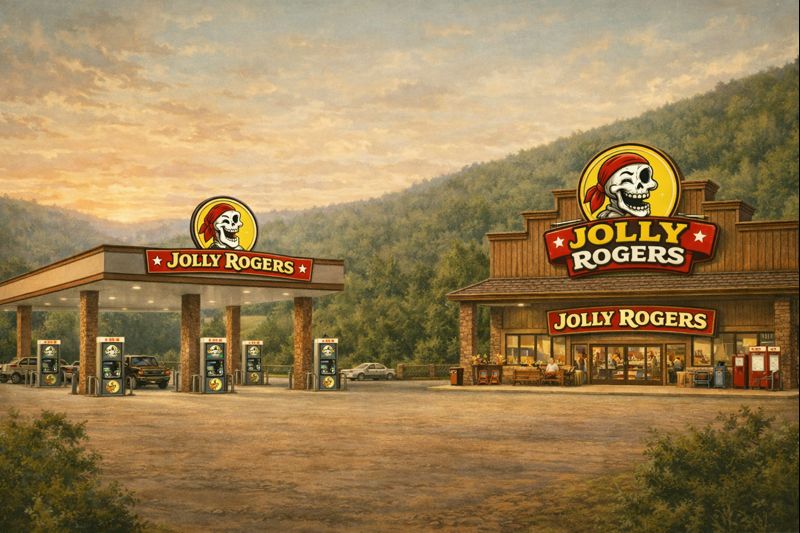
    And the place was a gas station. When they had gas.


    Next door, the Jolly Rogers Autoshop operated as a front for more questionable business—dragging off abandoned vehicles, stripping them for parts, and occasionally fixing tourists’ cars for a steep fee. Being the only shop around, people paid—grudgingly.

    Wade, the head mechanic, was under the hood of a gleaming silver Camry when Bob walked into the bay.

    Bob nudged his boot. “Up and at ‘em, loser.”

    “I’m really not in the mood for this today,” Wade groaned, rolling out on his creeper. Bob hauled him up.

    Grease smeared Wade’s beard and forehead. He rubbed a tender knot on his skull—courtesy of Mark during the leadership shift.

    “You good?” Bob asked.

    Wade shrugged. “It’s whatever. Chain of command is settled—even if it broke the code.”

    “Sean’s still pissed. So is everyone else.”

    Wade sighed. “What do you want, Bob?”

    “Mandy picked up a truck—Aardwelt.”

    “Aardwelt, huh?” Wade set a wrench onto the bench. “Who’s getting toy shipments out here?”

    “She didn’t say. Just a normal truck that wandered too close.”

    “You got make and model?”

    “Do I ever?” Bob said. “Talk to Mandy.”

    Wade grunted and wiped his hands. “People want you at the helm.”

    “I’m not fit for that.”

    “You’ve got the brains, the experience…”

    “And a bum leg,” Bob added. “How’s your lump?”

    Wade winced. “Mark’s gonna get his, eventually… Just ‘cause you can’t raid doesn’t mean you wouldn’t be a good Captain.”

    “I’m first mate. That’s enough.”

    Wade smirked. “For now.”

    Bob glanced around the mostly empty garage. “Where is everyone?”

    “Pat and JP are out collecting a few cars. Took the transporter.” Wade flipped open the logbook and scowled at the handwriting. “Chicken scratch…”

    “They take the right paperwork?”

    “They know the rules,” Wade smiled, “If not, they’ll wish they had.”

    Bob nodded. Police tended to avoid the Triangle—but lines were occasionally crossed. And when people left their cars out here… they were rarely seen again.

    Bones turned up sometimes. Gnawed on with chunks of meat.

    He didn’t like to think about it.


    “Bob.”

    Wade’s voice pulled him from the memory.

    “Go find Mark. If we’re raiding, he should lead after all. And if you see Molly, tell her to get back on radio. Pat and JP might need backup.”

    Wade left for the store.

    Bob stepped outside, his right leg tingling. Raids used to thrill him. Now, just walking made him think of scared truckers and blood.

    He headed for the Lounge. Mark would be there—flirting with Amy, the Aos Sí bartender and probably striking out. Nereid, she called herself. Whatever. She was human enough not to scare away guests.

    Sure enough, Mark was at the bar, sipping a drink, while Amy vanished to the back.

    “Oi, Captain,” Bob called. “Got a minute?”

    Mark raised his eyebrows, lips pursed.

    “No need for that, Captain,” Bob smirked. “Pretty sure you’re annoying her.”

    “I’m wearing her down,” Mark grinned. “I’m making progress.”

    “Sure, you are. Anyway, Mandy picked up a signal. Aardwelt truck.”

    “Ohh,” Mark perked up. “They’ve got some really cool stuff. Wild tech. Way more advanced than the toys we grew up with.”

    “Also, defective. You’ve read the lawsuits, right?”

    Mark sipped again. “I’ve read ‘em.”

    “I’ve got concerns, Captain.”

    “You always do.”

    Bob hesitated. “This shipment… it might not be safe.”

    Mark waved it off. “Then we test it ourselves. That’s the fun part.”

    “You’re seriously sending a crew?”

    “I want you riding shotgun with me.”

    Bob froze. “I don’t do raids anymore.”

    “Time to squash that fear. We’ve evolved. New tactics, new tools—”

    “Still feels wrong, Mark.” Bob clenched his fist, then let it go. “This one’s different. I’ve got a bad feeling.”